Electronics & Communication
Electronics & Communication Engineering
The department began its journey in 1994 as the Department of Electronics and Telecommunication Engineering with an intake of 60 students. Over the years, it has evolved into a vibrant centre of technology and learning. Today, the department offers B.Tech. programmes in Electronics and Communication Engineering with an intake of 180 and EC – Advanced Communication Technology with an intake of 60, along with a Postgraduate programme in Embedded Systems and VLSI Design with an intake of 30 students. These programmes provide students with a strong foundation in electronics, communication, semiconductor technologies, embedded systems, signal processing, and advanced digital technologies, while creating opportunities to specialize in emerging areas.
The department is supported by a team of highly qualified, experienced, and dedicated faculty members, representing diverse areas of specialization. Faculty members are actively engaged in teaching, research, consultancy, innovation, industry interaction, and professional development, thereby creating a rich academic environment that encourages students to learn, explore, innovate, and excel.
A significant milestone in the department’s journey has been its consistent commitment to quality assurance and academic excellence through NBA accreditation. The department has been accredited by the National Board of Accreditation four Times, reflecting its sustained efforts towards quality education, outcome-based learning, continuous improvement, industry relevance, and attainment of graduate attributes. This repeated accreditation is a testament to the department’s commitment to maintaining academic standards and providing students with education aligned with national and international expectations.
The department follows a student-centric and outcome-based education framework, integrating classroom teaching with experiential learning, laboratory practice, project-based learning, internships, industrial exposure, technical training, research, and innovation. Students are encouraged to participate in national and international competitions, hackathons, technical quizzes, design challenges, paper presentations, workshops, seminars, and professional development activities.
In keeping with the rapidly changing technological landscape, the department has expanded its academic and practical focus to include MATLAB, Tina Designsuite educational licenced software ,Artificial Intelligence and Machine Learning, Internet of Things, 5G and Advanced Wireless Communication, Embedded Systems, Robotics and Automation, Drone and UAV Technologies, VLSI and FPGA Design, SIMTEL 08(Analog Electronics),SIMTEL 09(Digital Electronics),SIMTEL 10(Analog Communication) Semiconductor Technologies, Software Defined Radio, Digital Signal Processing, Computer Vision, Edge Computing, Industrial IoT, and Smart Energy Systems.
The department is supported by 16 specialized laboratories equipped with contemporary hardware, development platforms, measuring instruments, communication systems, simulation tools, and industry-relevant software. These facilities provide students with opportunities to transform theoretical concepts into practical systems and prototypes and to develop solutions for real-world engineering challenges.
Research and innovation form an integral part of the department’s academic culture. Faculty members and students are encouraged to undertake sponsored research, industry-collaborative projects, consultancy, publications, intellectual property development, technology demonstrations, and interdisciplinary research. The department promotes research in VLSI and semiconductor design, AI-enabled electronics, IoT, intelligent embedded systems, communication technologies, signal and image processing, robotics, UAV systems, and other emerging areas.
The department also places strong emphasis on industry-academia collaboration through MoUs, internships, industrial visits, expert lectures, skill-development programmes, industry projects, and consultancy activities. These initiatives enable students to understand industrial practices and develop the technical, professional, and interpersonal skills required to succeed in a competitive global environment.
The overarching objective of the department is to foster the holistic development of every student by providing a conducive learning environment that combines academic rigor with innovation, research, professional ethics, leadership, entrepreneurship, and social responsibility.
With its strong academic foundation, continuously evolving technological ecosystem, qualified faculty, modern laboratories, research orientation, industry engagement, and commitment to quality, the Department of Electronics and Communication Engineering, LNCT Bhopal, is dedicated to creating engineers who are not only industry-ready but also capable of becoming innovators, researchers, entrepreneurs, technology leaders, and responsible citizens.
The department’s commitment is simple yet ambitious: to transform knowledge into innovation, innovation into impact, and students into professionals who can shape the technologies of tomorrow. The student’s editorial board also publishes a monthly departmental newsletter “ACRUX” which speaks about quality of the students. Research assistance for paper presentation and travel grants for India and abroad are provided by LNCT and government agencies like MPCST, AICTE, DST etc.
B.Tech in Electronics and Communication Engineering ( 4 Years )
| College Name | Lakshmi Narain College of Technology |
| Year of Approval | 1994 |
| Accreditation Status | Accredited NBA for 3 years under Tier II (2007-2010) Accredited NBA for 3 years under Tier II (2017-2020) Accredited NBA for 3 years under Tier II (2020-2023) Accredited NBA for 3 years under Tier II (2023-2026) |
| Professional Society Memberships | IEEE, ISTE, IETE. IEEE Student Chapter |
| Professional Activities | 1. IEEE Student chapter Societies which are actively conducting Seminars, Internships, Workshops , FDPs, Hackathons: 2. Memorandum of Understanding (MOU) signed: > Bharat Sanchar Nigam Limited, known as BSNL, is a government-owned public sector telecommunications company in India, Scientech Technologies Pvt. Ltd., Indeyes infotech pvt ltd, Stride Tech Bhopal, ARIST Automation, Robonauts IndiaCentre for Research and Industrial Staff Performance(CRISP), Infosys Springboard ,AICTE, Wipro Ltd. India ,Tata Consultancy Services Ltd. ,Cognizant Foundation, NASSCOM, ARTECH Infosystem Pvt. Ltd., Servicenow, Ericsson India Pvt. Ltd. ,ITE Infotech Pvt. Ltd. Bhopal, Cybrom Technology Pvt. Ltd., JustDial, Amazon Web Services India Pvt. Ltd., Kulchuri Software Solutions Pvt. Ltd., CISCO |
| Grants Fetched | EXTERNAL FUNDED RESEARCH – 2024-25: i) Dr. Shravan Kumar Sable, Associate Professors: AICTE-Inter-Institutional Biomedical Innovation Programme(IBIP) Funded by AICTE, New Delhi-110070, Rs.10,00,000 – 2years [First Phase Rs. 5,00,000/-] |
| Departmental Achievements | 1. Faculties presented their research work and invited as guest speakers all over India and abroad. 2. Faculties and Technical staff are actively participating in inter-departmental as well as inter-collegiate sports competitions and got laurels to the college and the department. 3. Organized visits to various industries CPRI,BSNL,IISER,CRISP,HEG,ISRO-BHOPAL etc. 4. Faculties are granted and applied for patents. 5. Faculties and students have a number of quality publications in various Journals. |
| Eligibility Criteria | Eligibility-XII with: Physics + Maths + (Chemistry/Computer Science/Biology) with Min. 45% (40% for SC/ST/OBC MP Domicile Candidate) with qualified rank in JEE. Eligibility (Direct/Lateral Entry)-2nd Year. Direct Admission: 1. Min. 45% (40% for SC/ST/OBC) in B.Sc. and passed 12th examination with Maths. 2. Min. 45% (40% for SC/ST/OBC) in Diploma in Engg. |
| Seats | 240 |
| Special Courses | Advanced Communication Technology – Based on 5G Technology (60 Seats) |
| Duration | 4 Years |
M.E in Embedded System and VLSI Design ( 2 Years )
| College Name | Lakshmi Narain College of Technology |
| Year of Approval | 2008 |
| Level | PG |
| Eligibility Criteria | Eligibility – B.Tech. with Min. 50% (45% for SC/ST/OBC MP Domicile Candidate) |
| Seats | 30 |
| Duration | 2 Years |
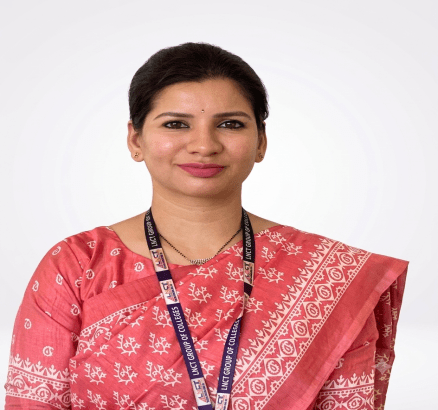
| College Name | Name |
| LNCT | Dr. Amrita Pahadia |
Faculty Achievements
IPR Achievements
Publications
Social Responsibility
Student Chapters - Activities
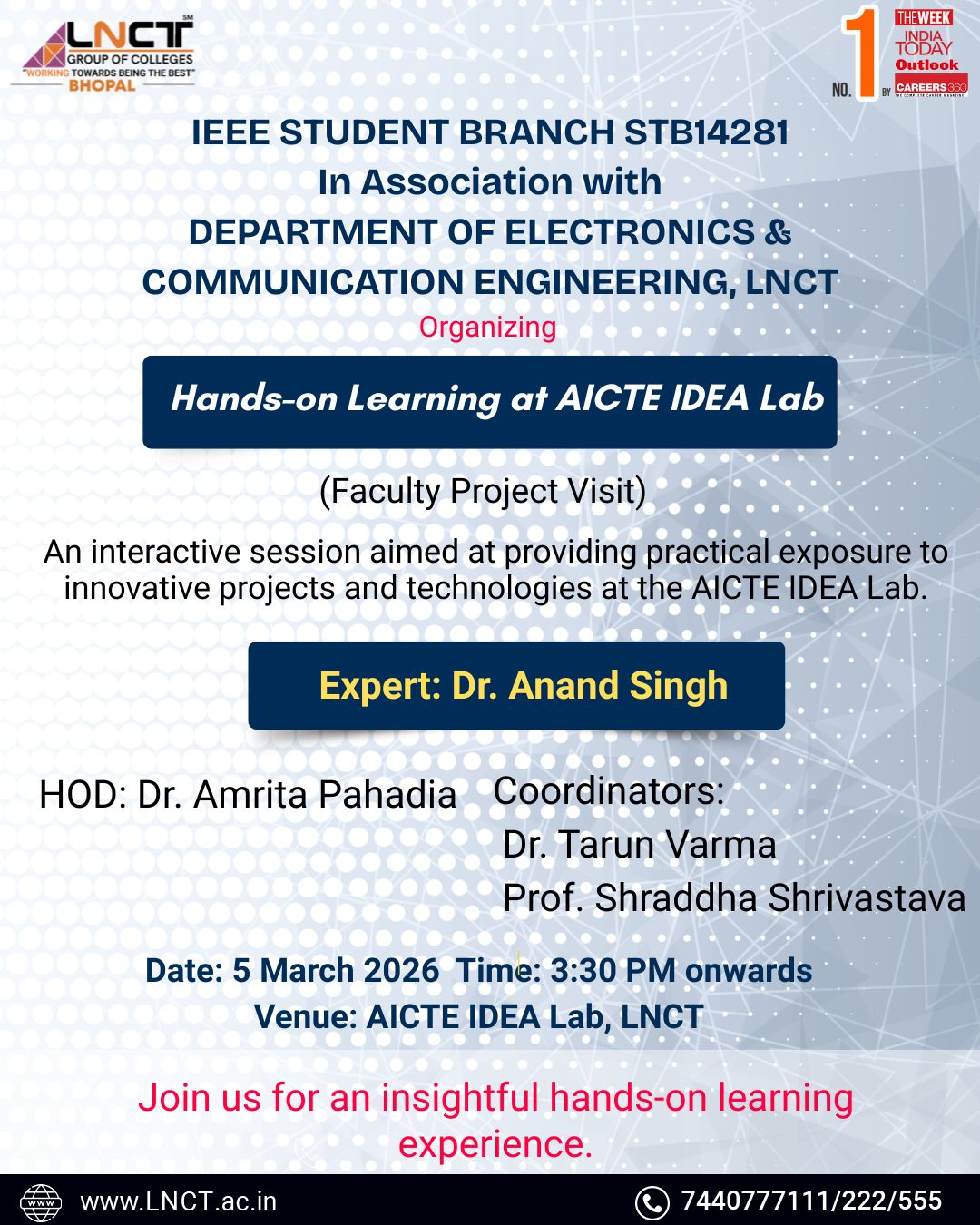
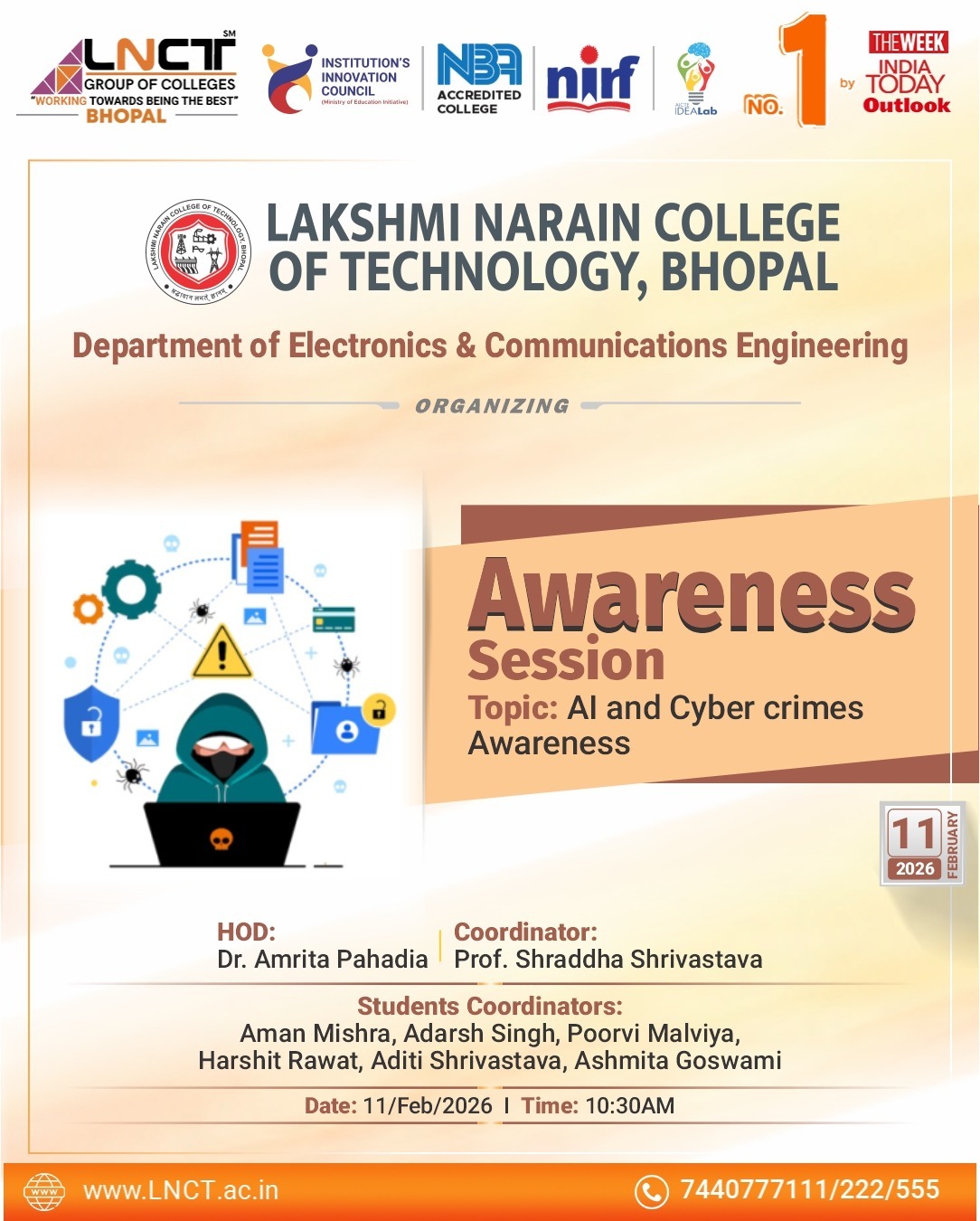
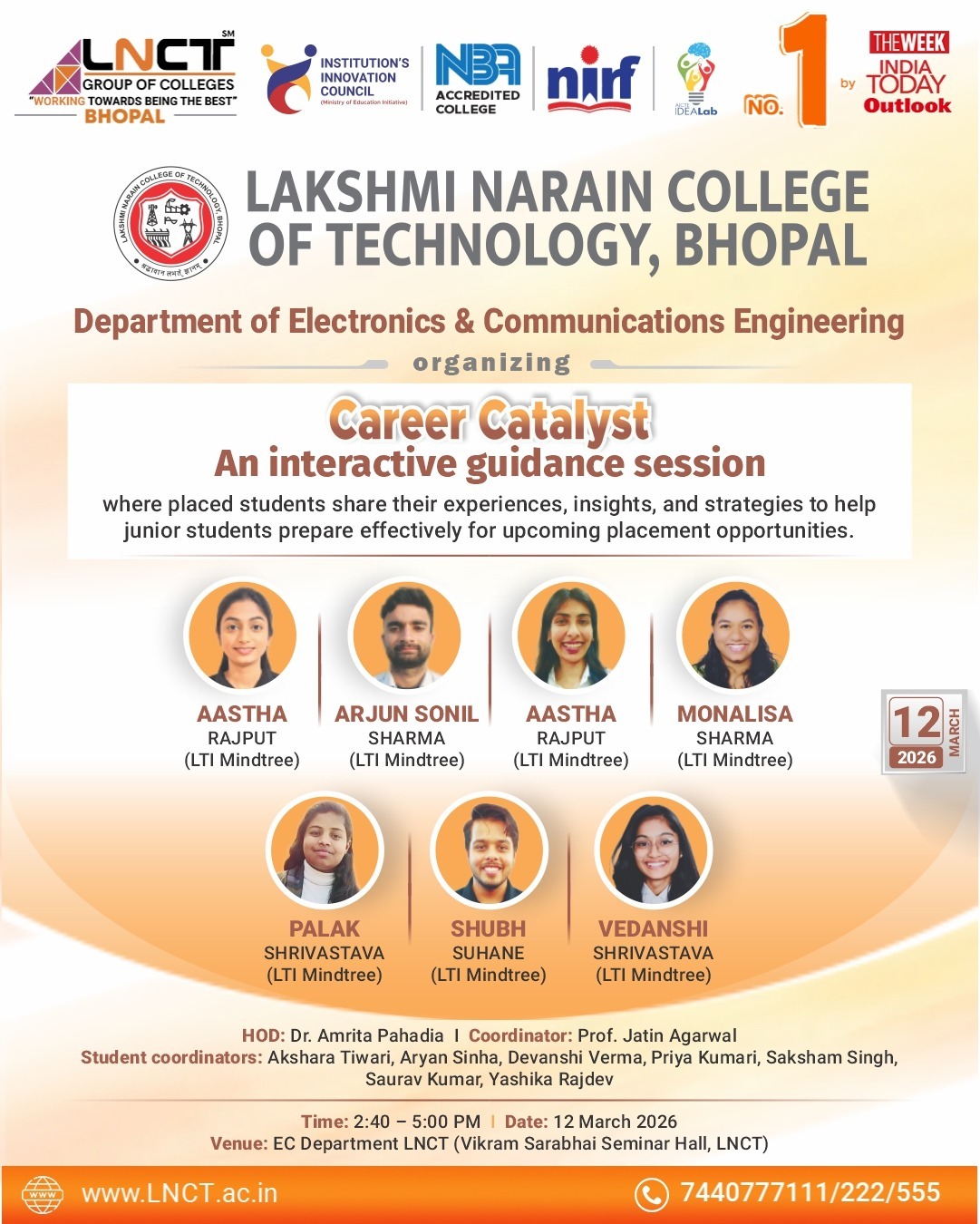
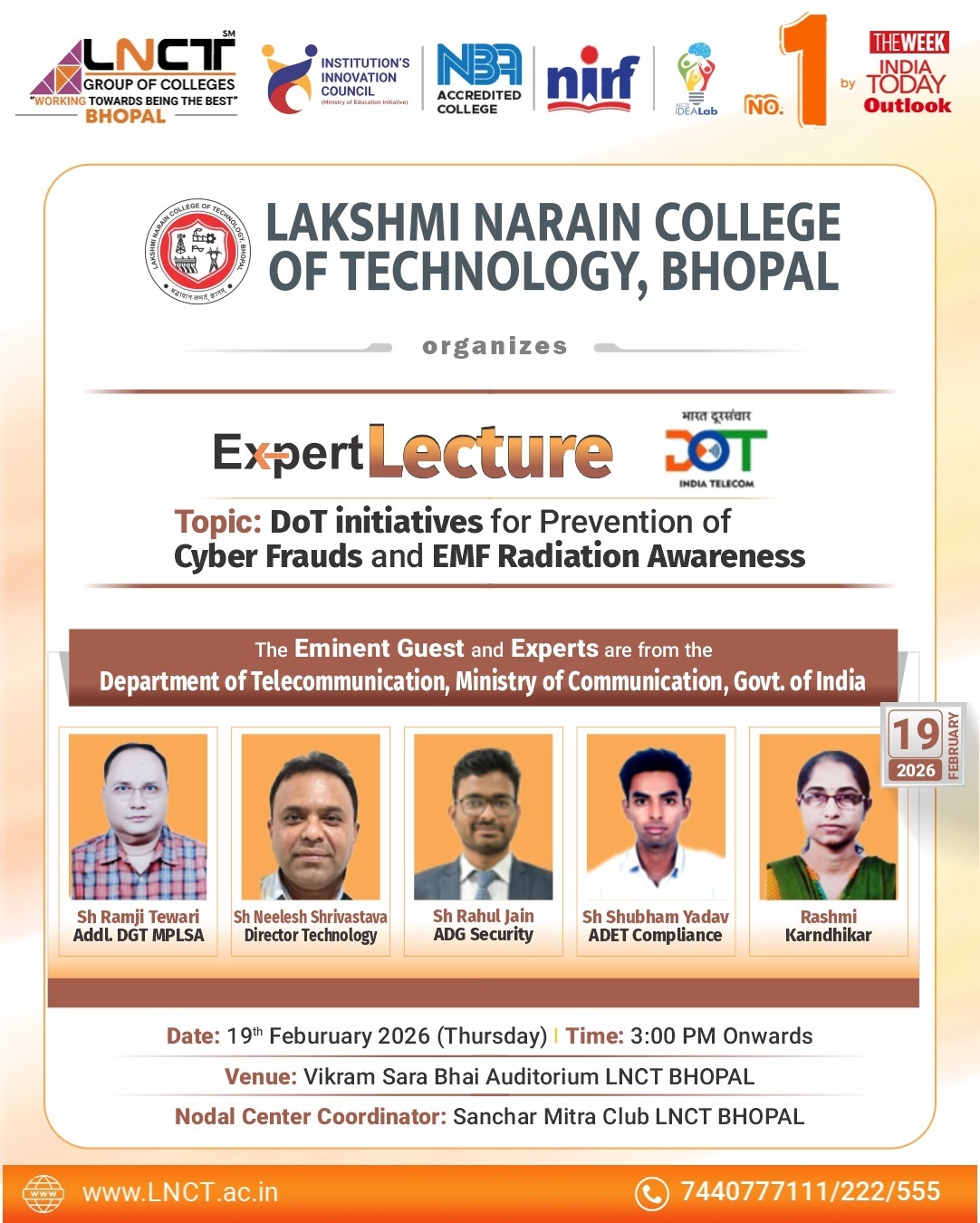
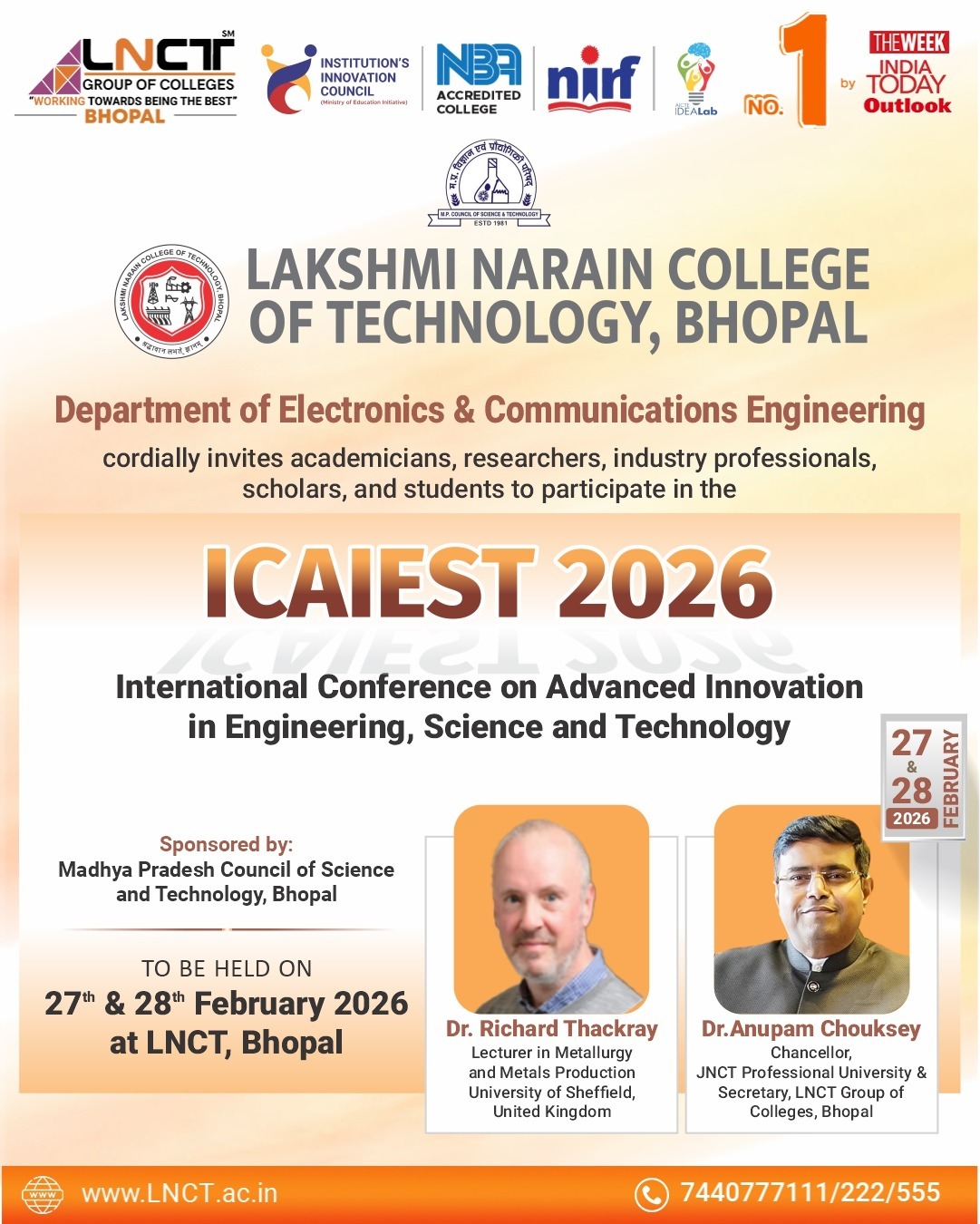
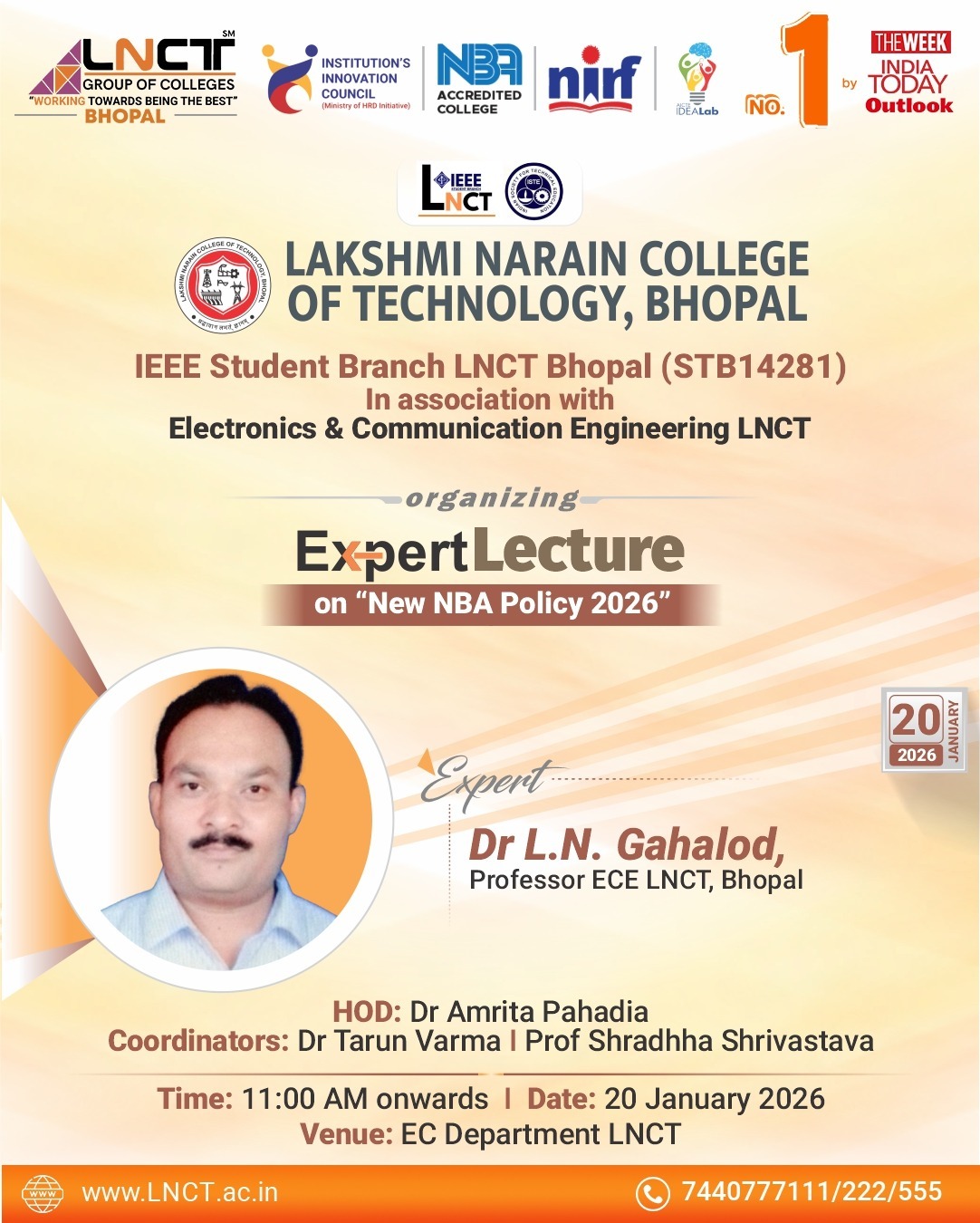
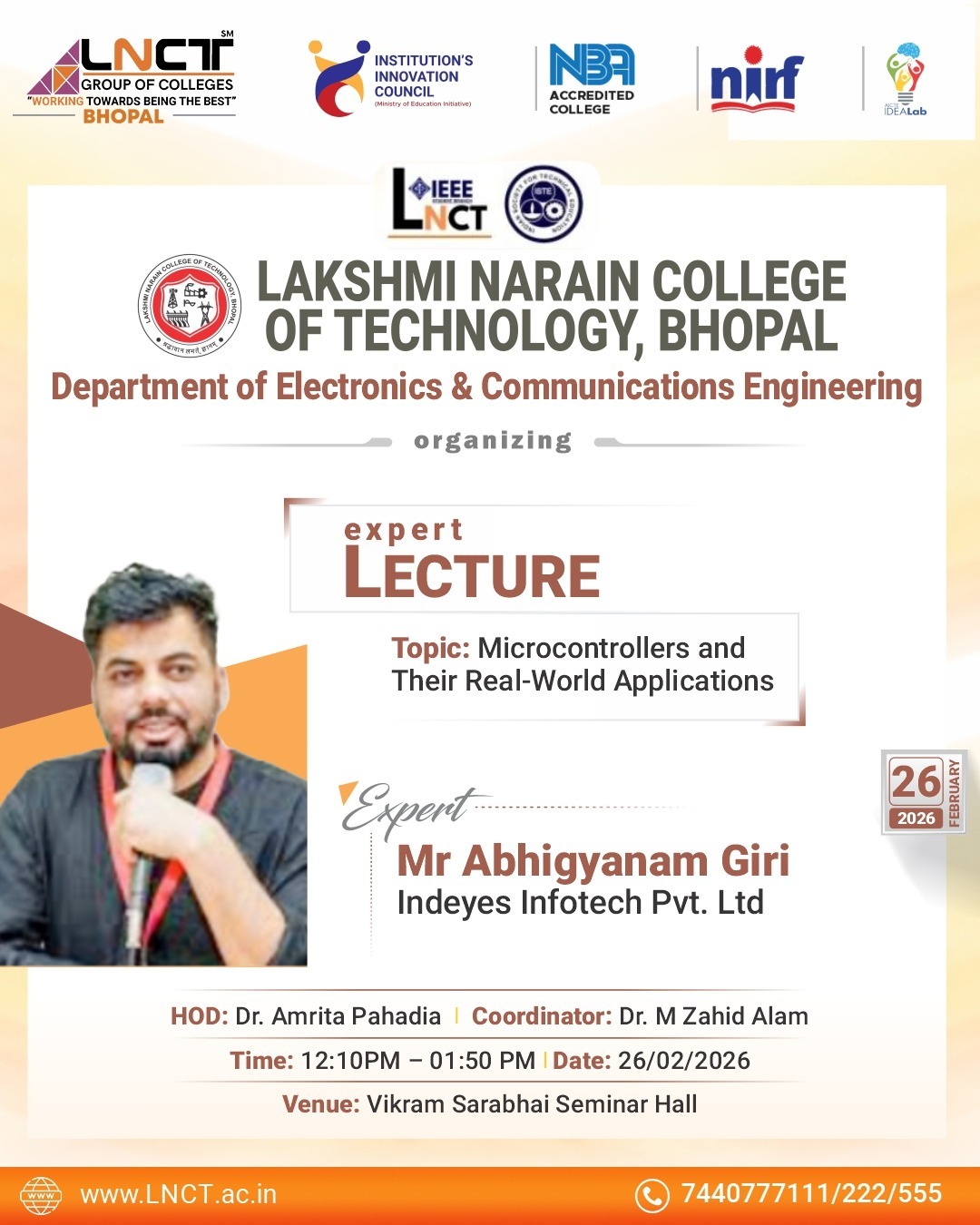
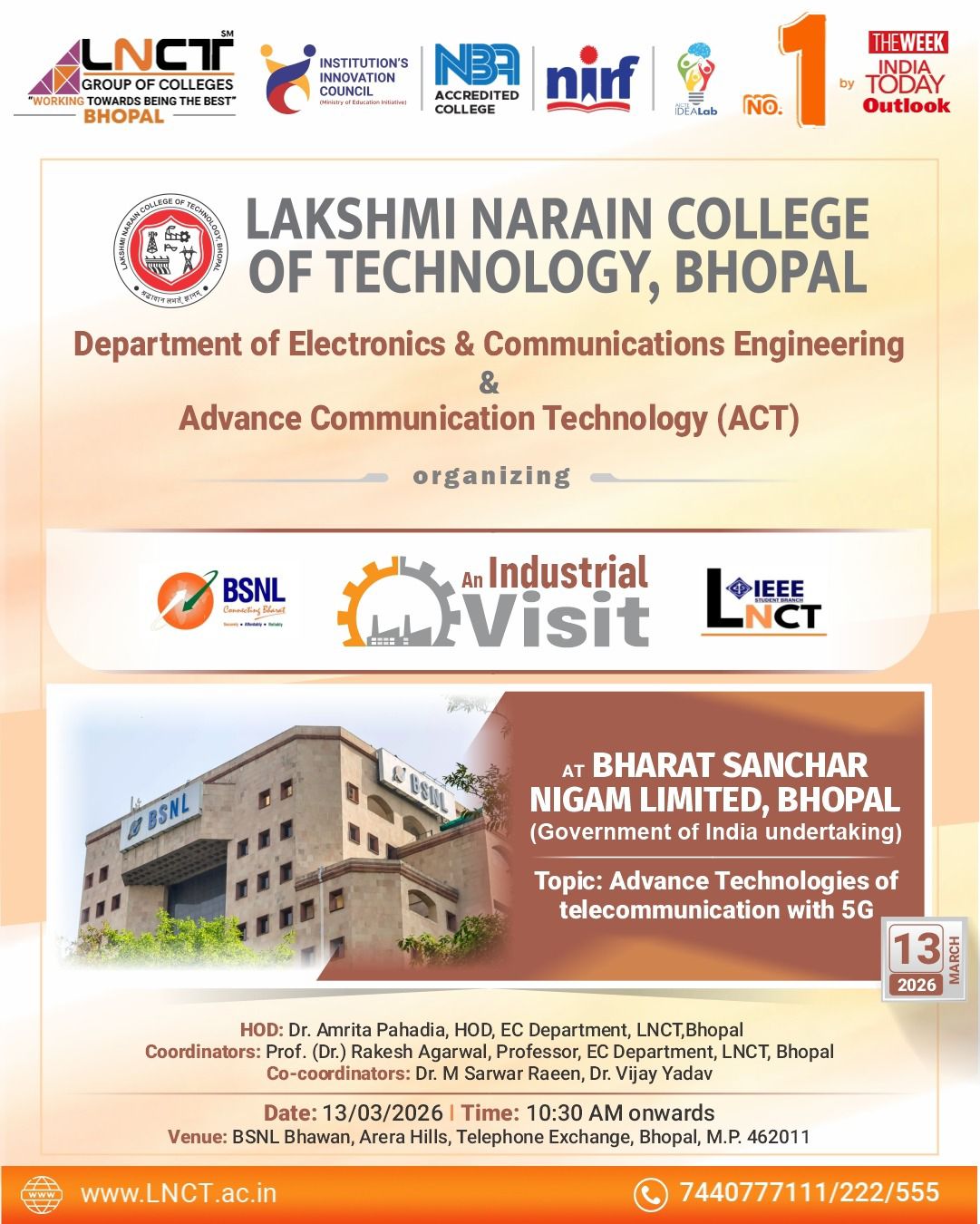
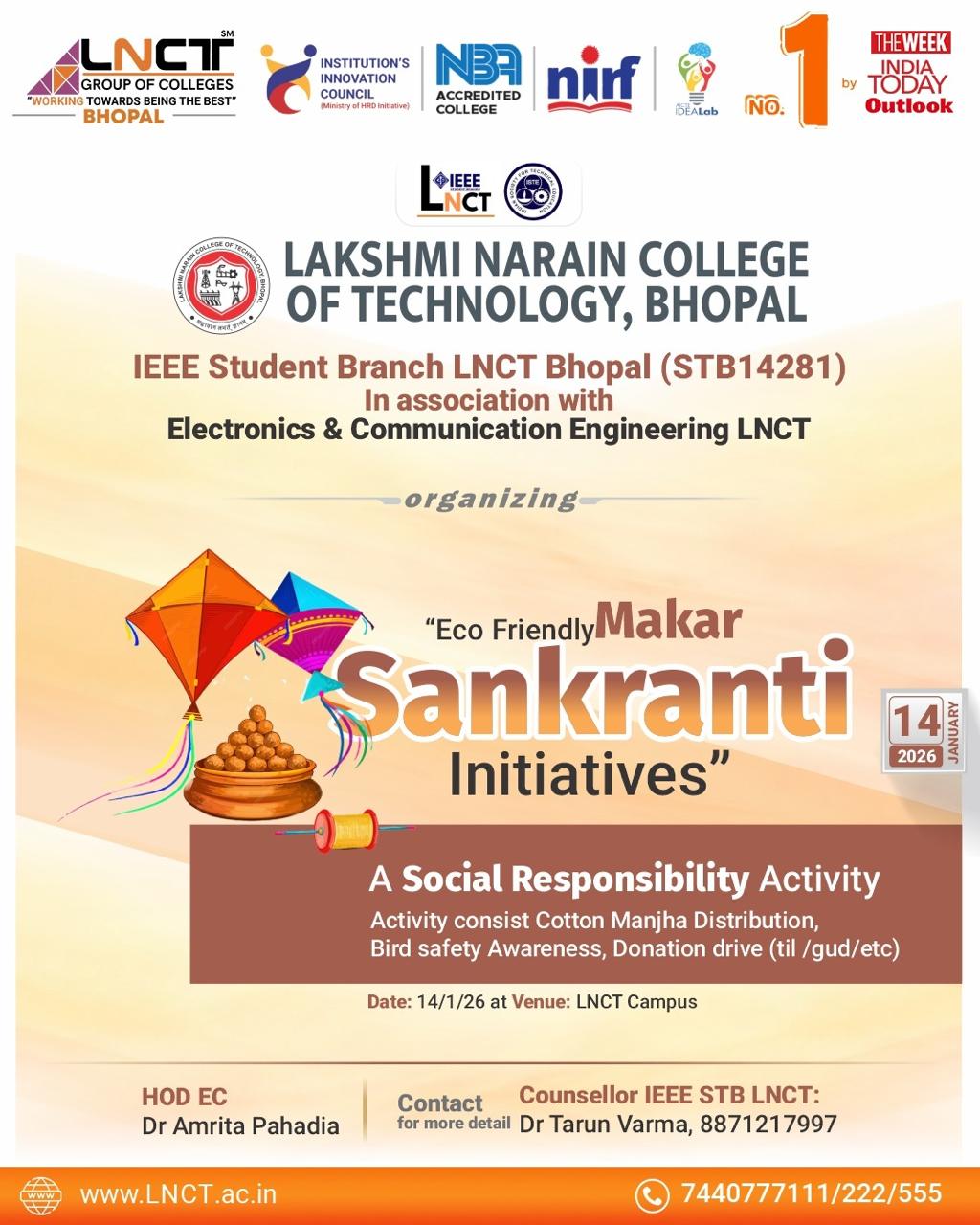
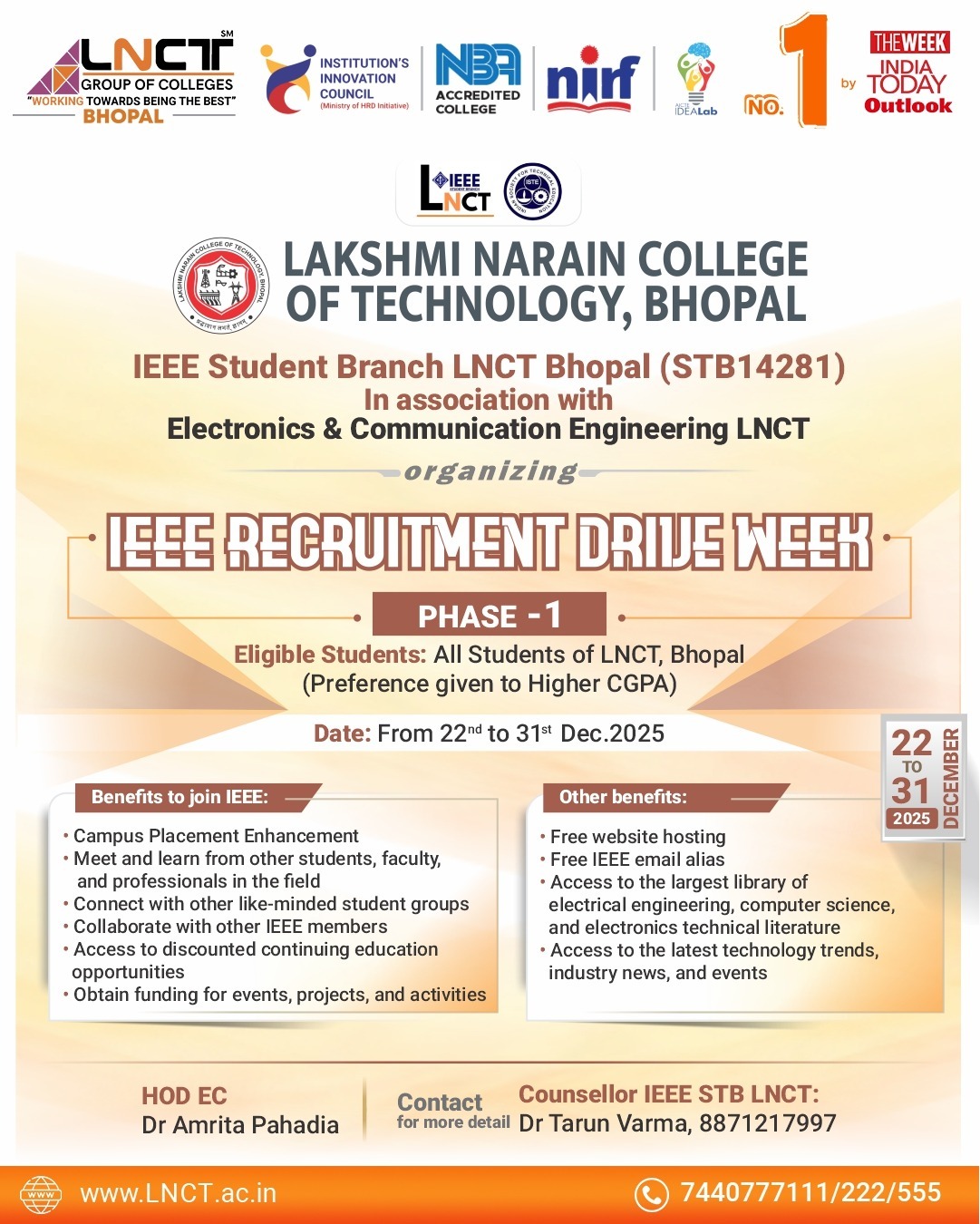
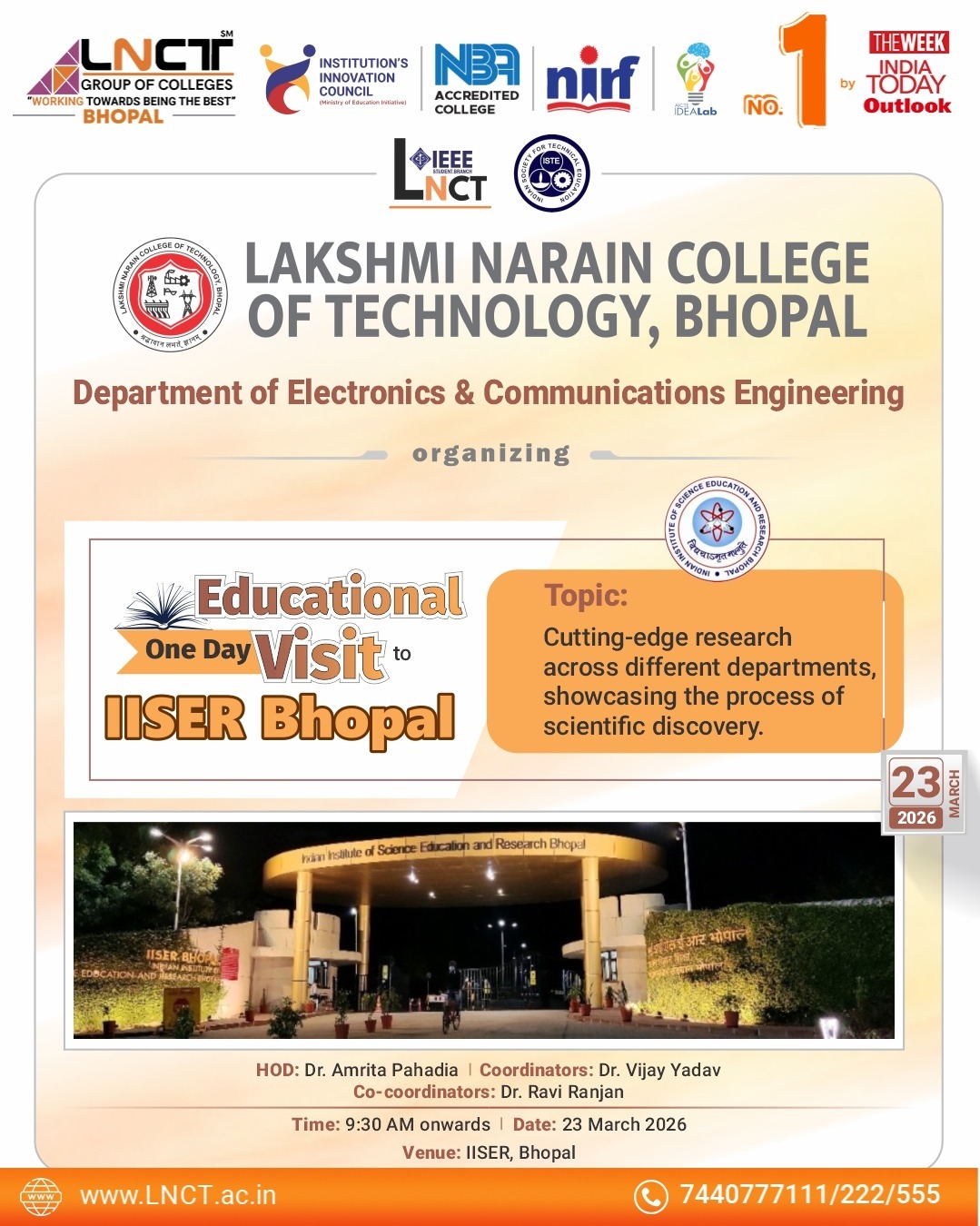
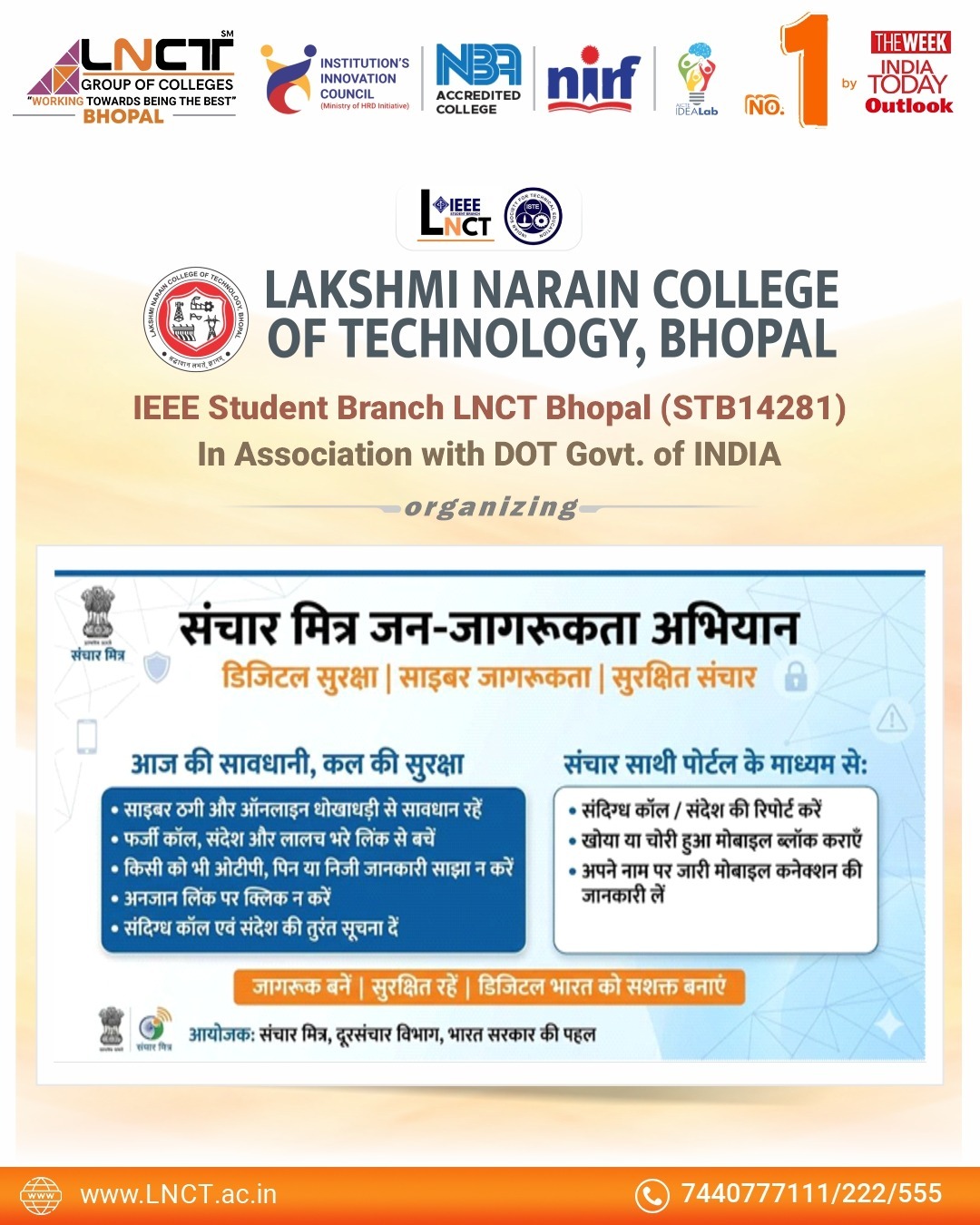
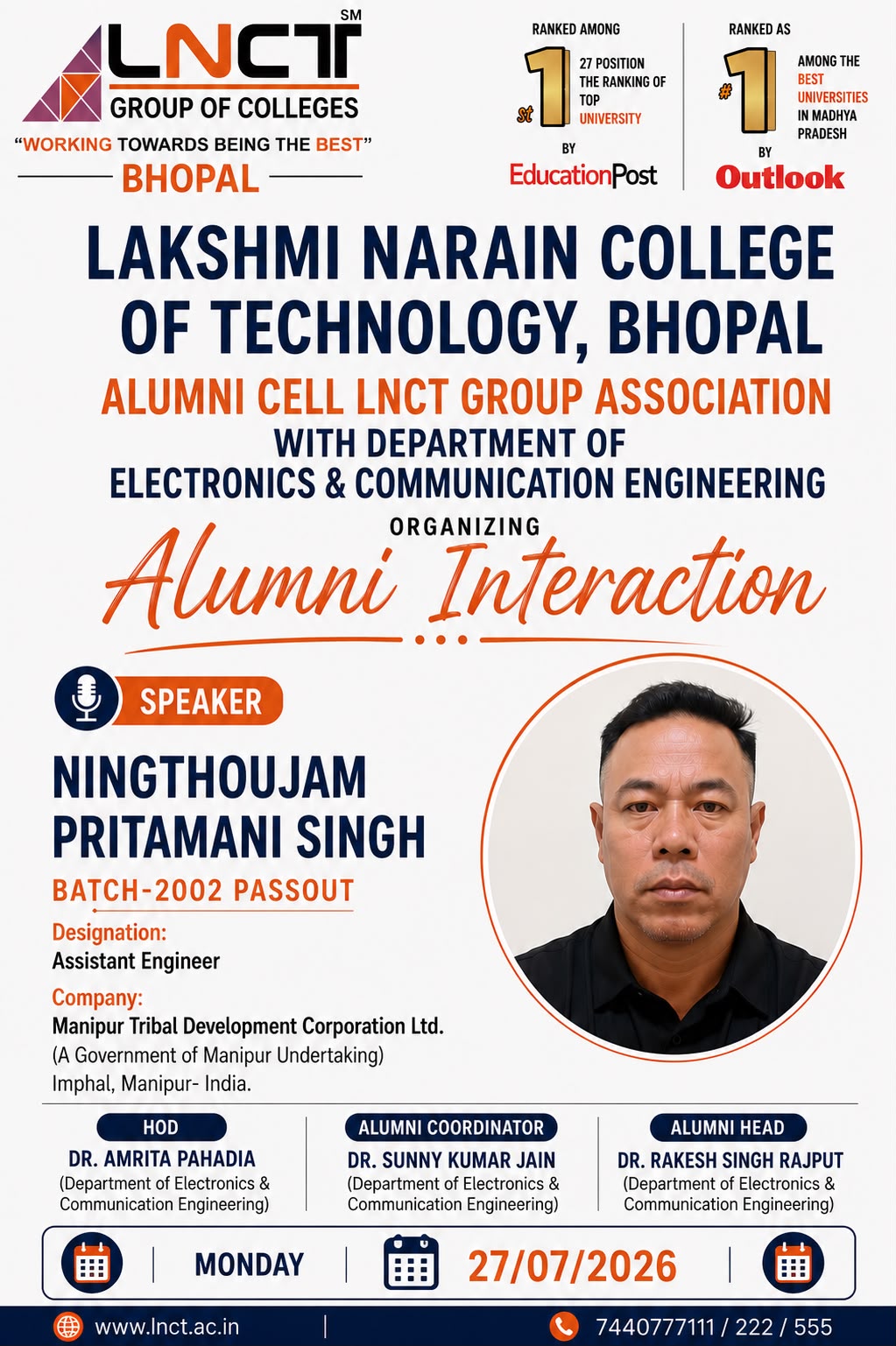
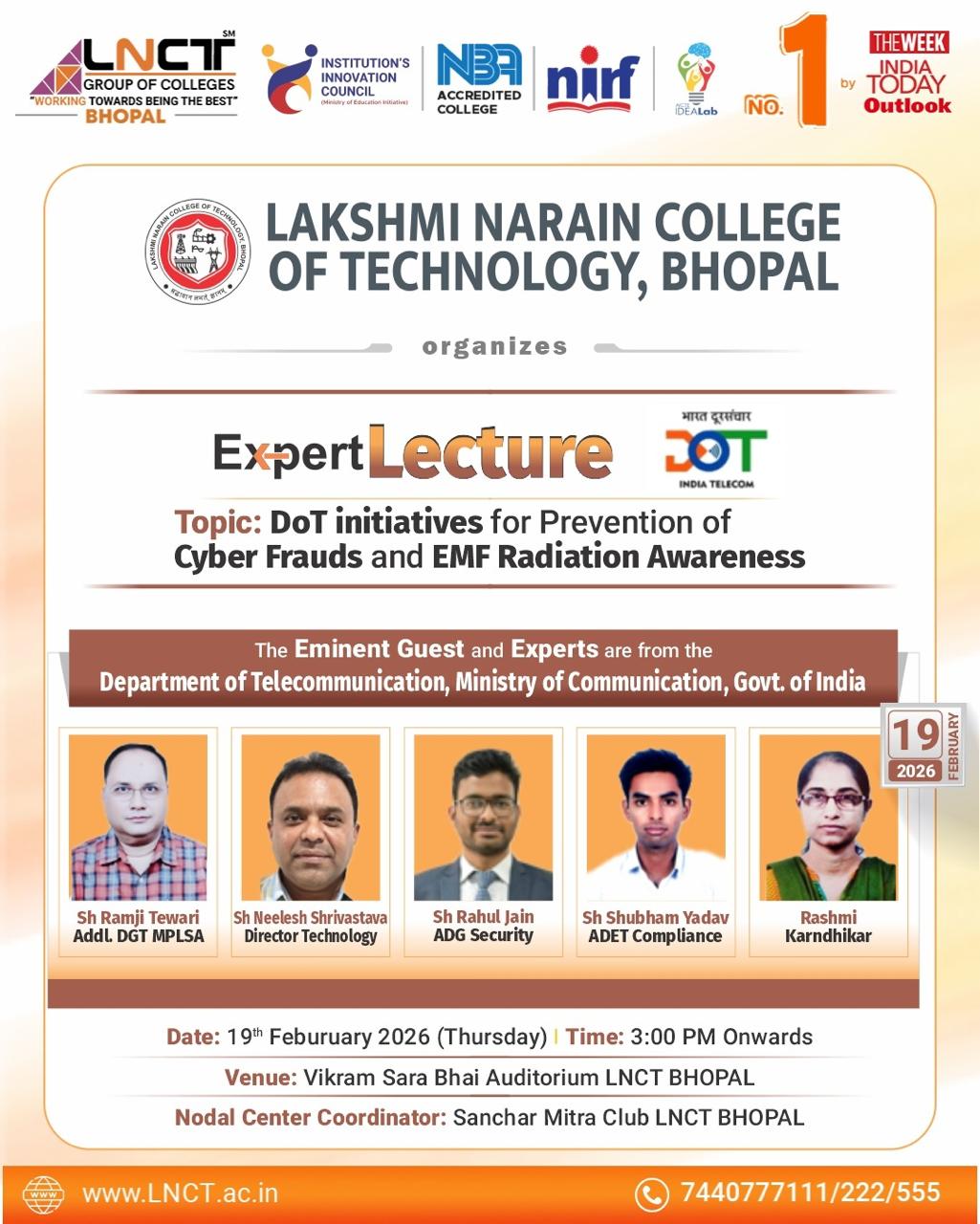
Talks / Lecturers / Seminars - Activities
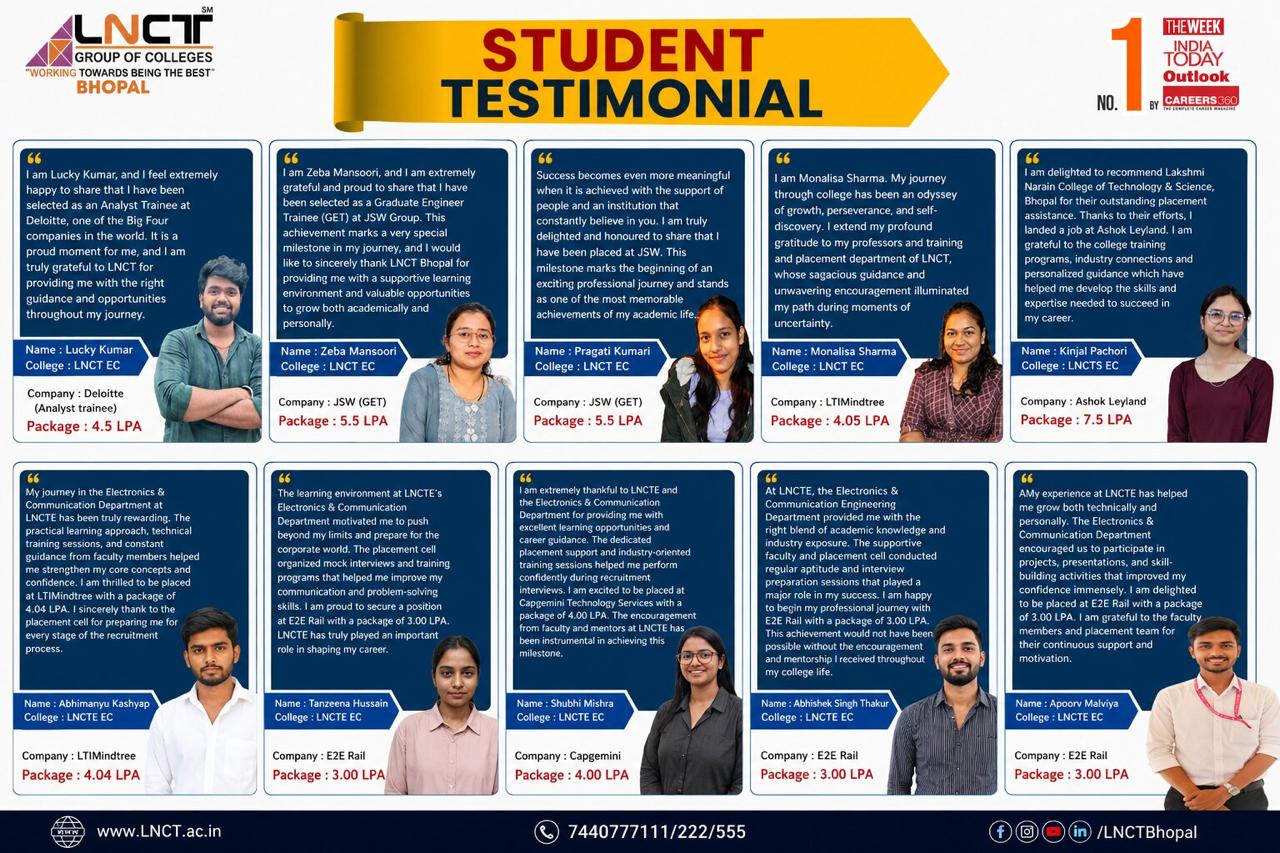
Testimonials
News And Events
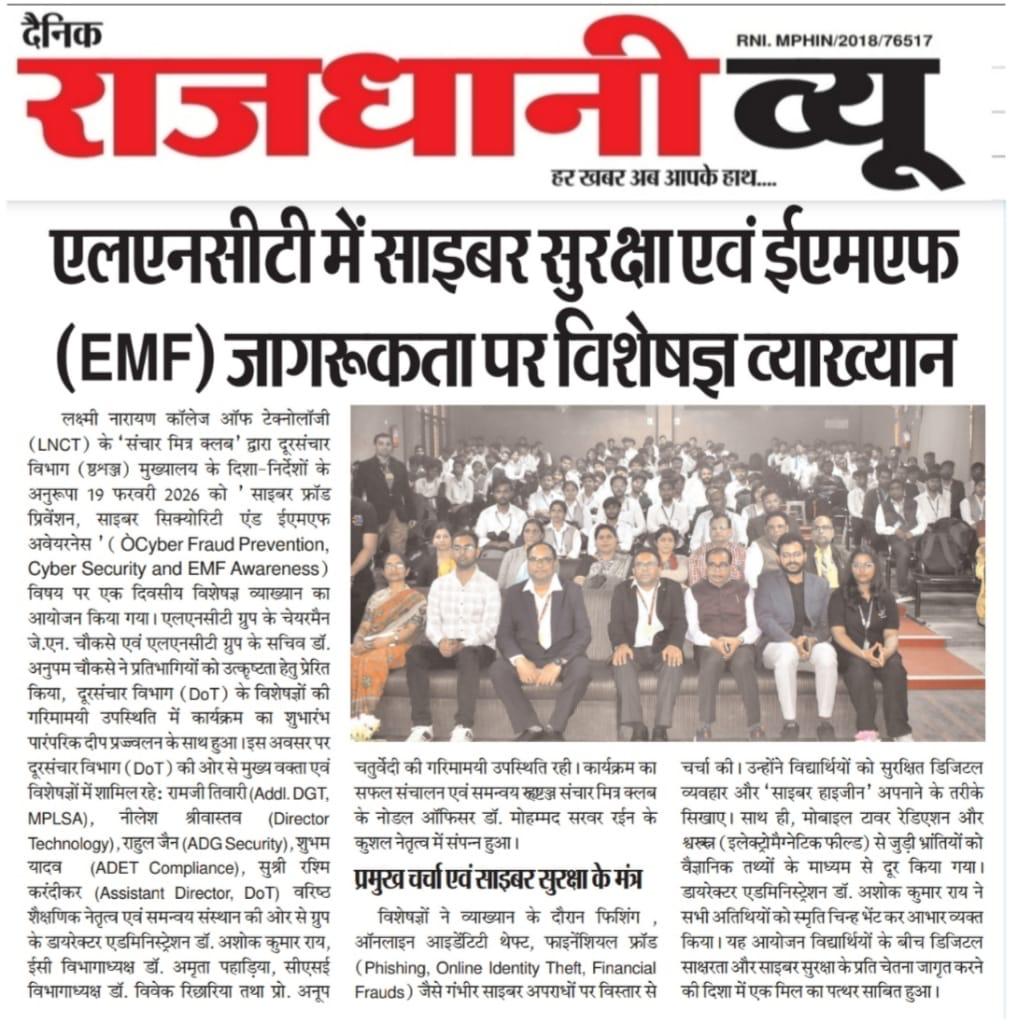
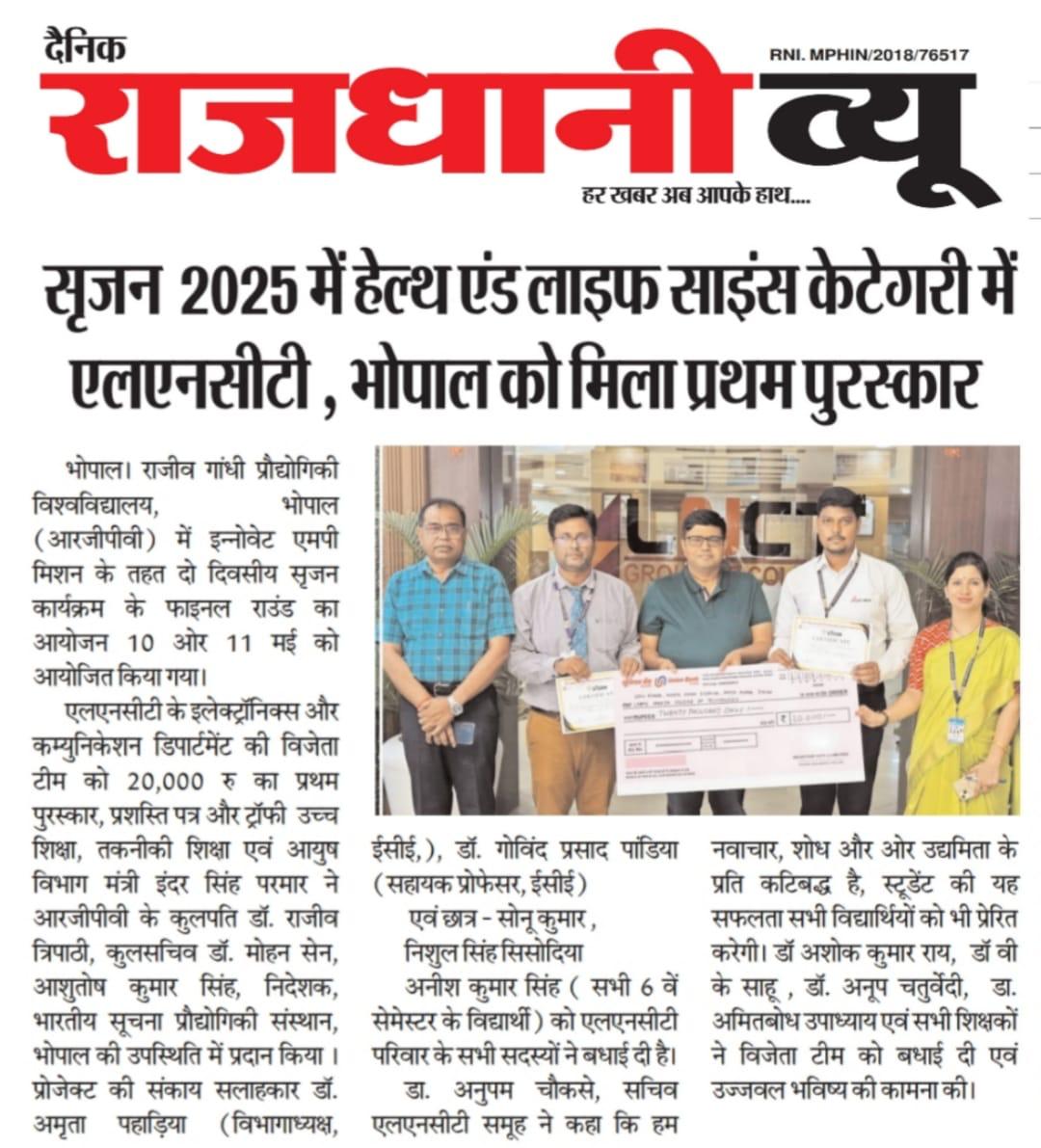
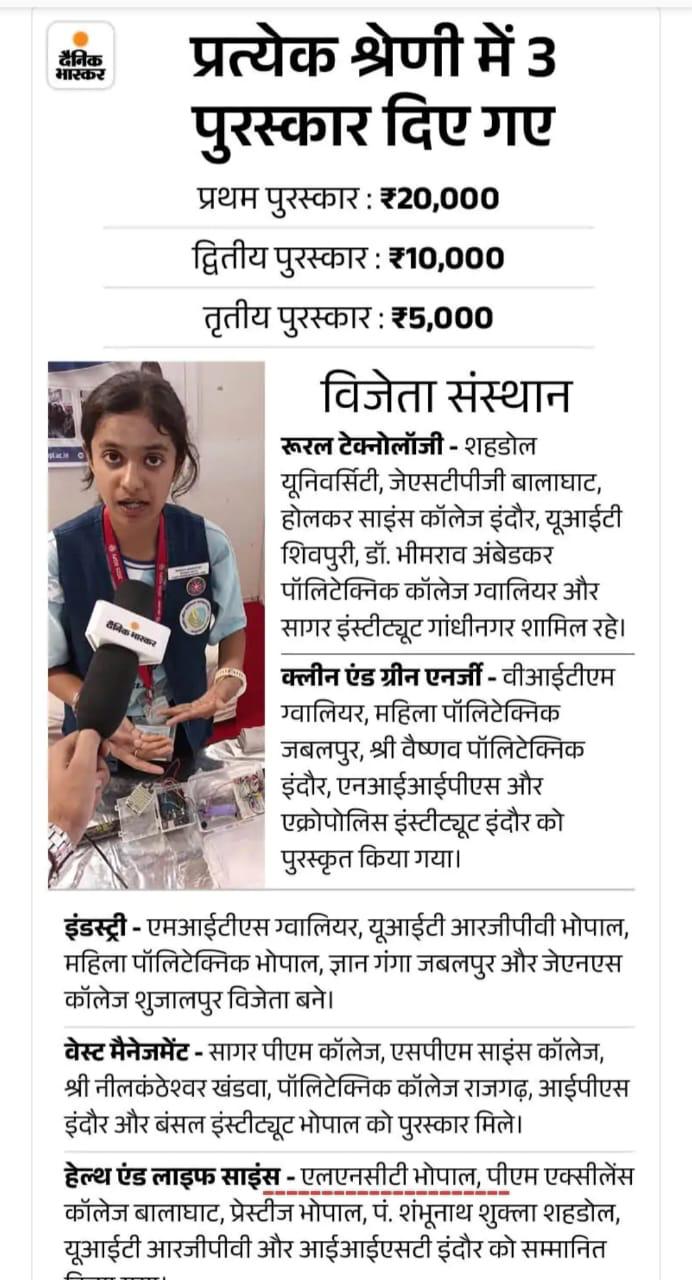
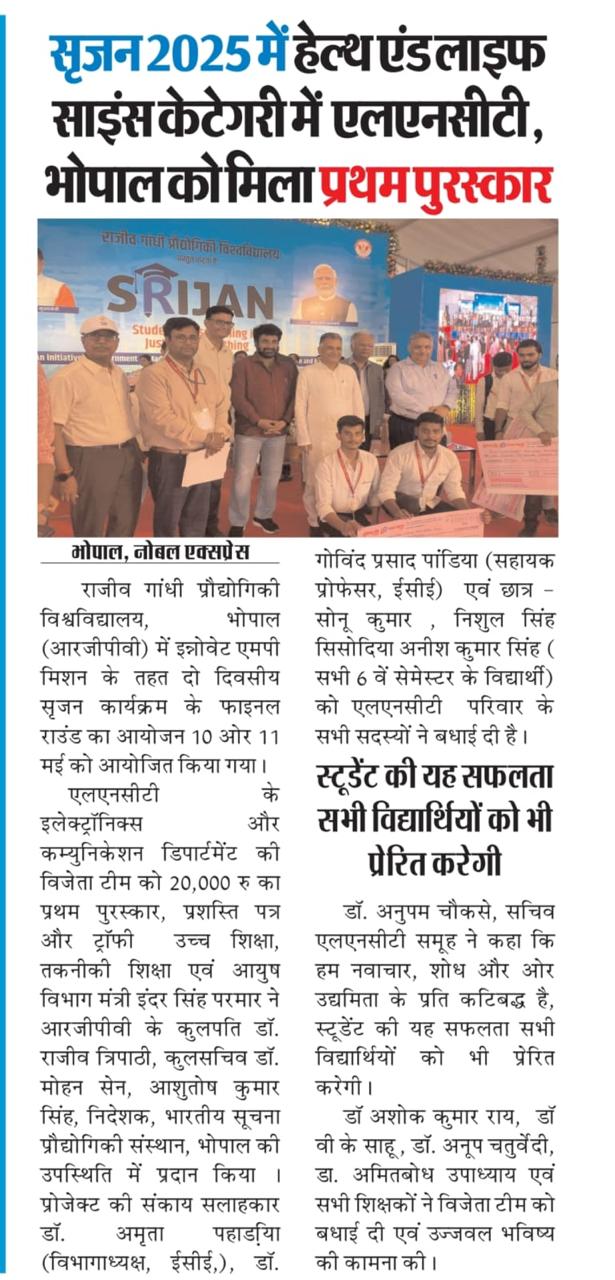
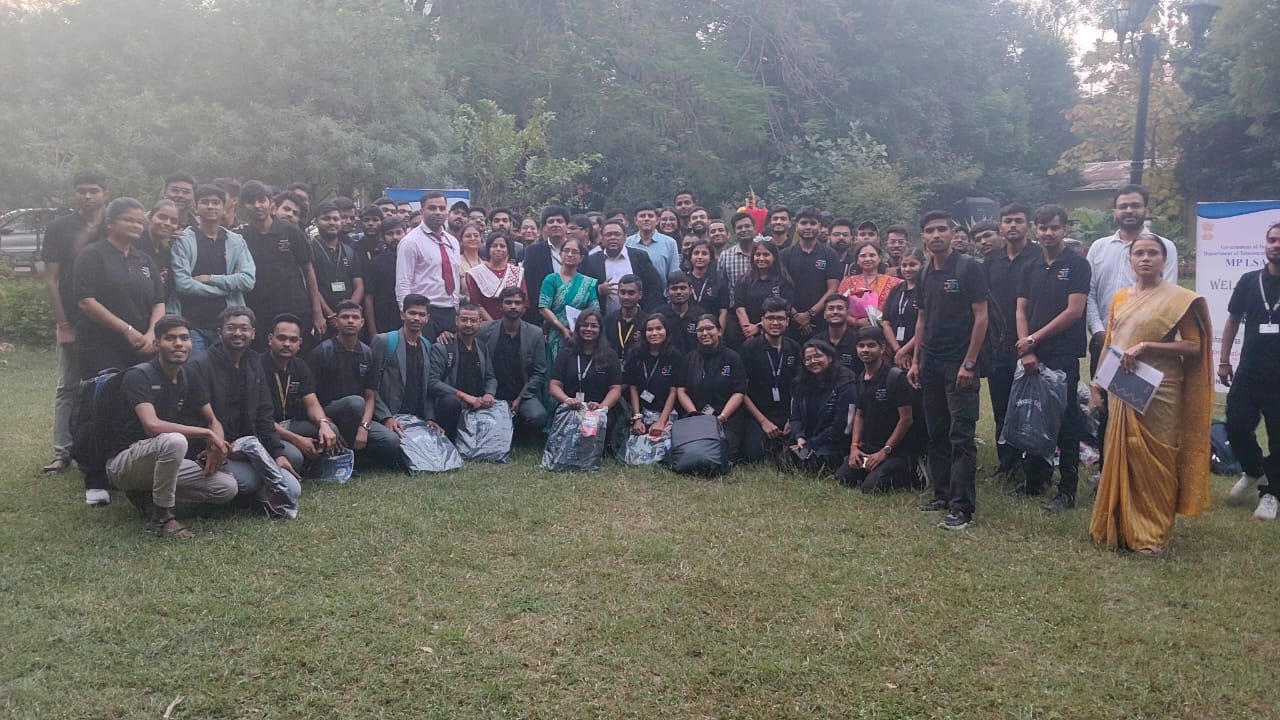
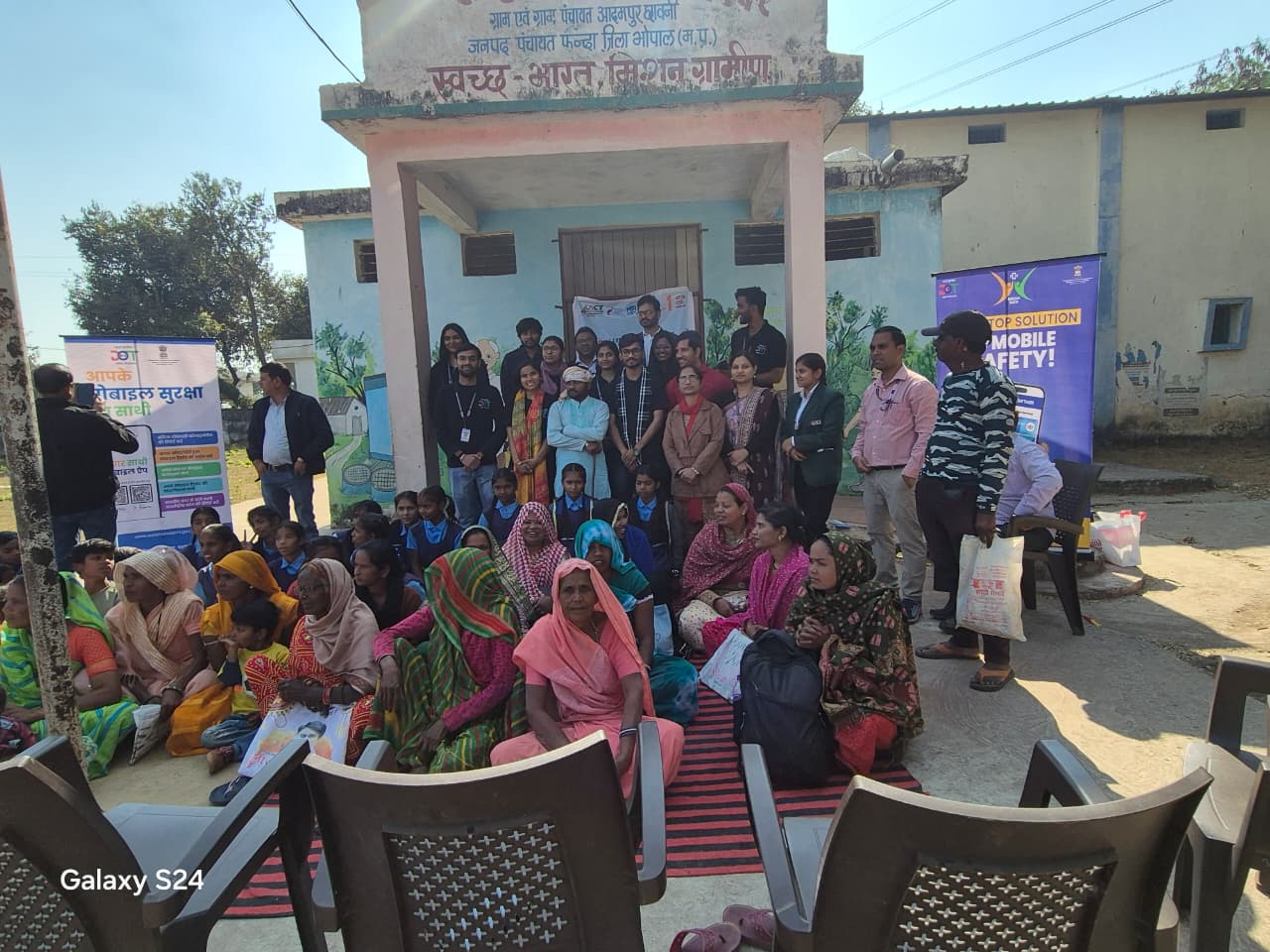
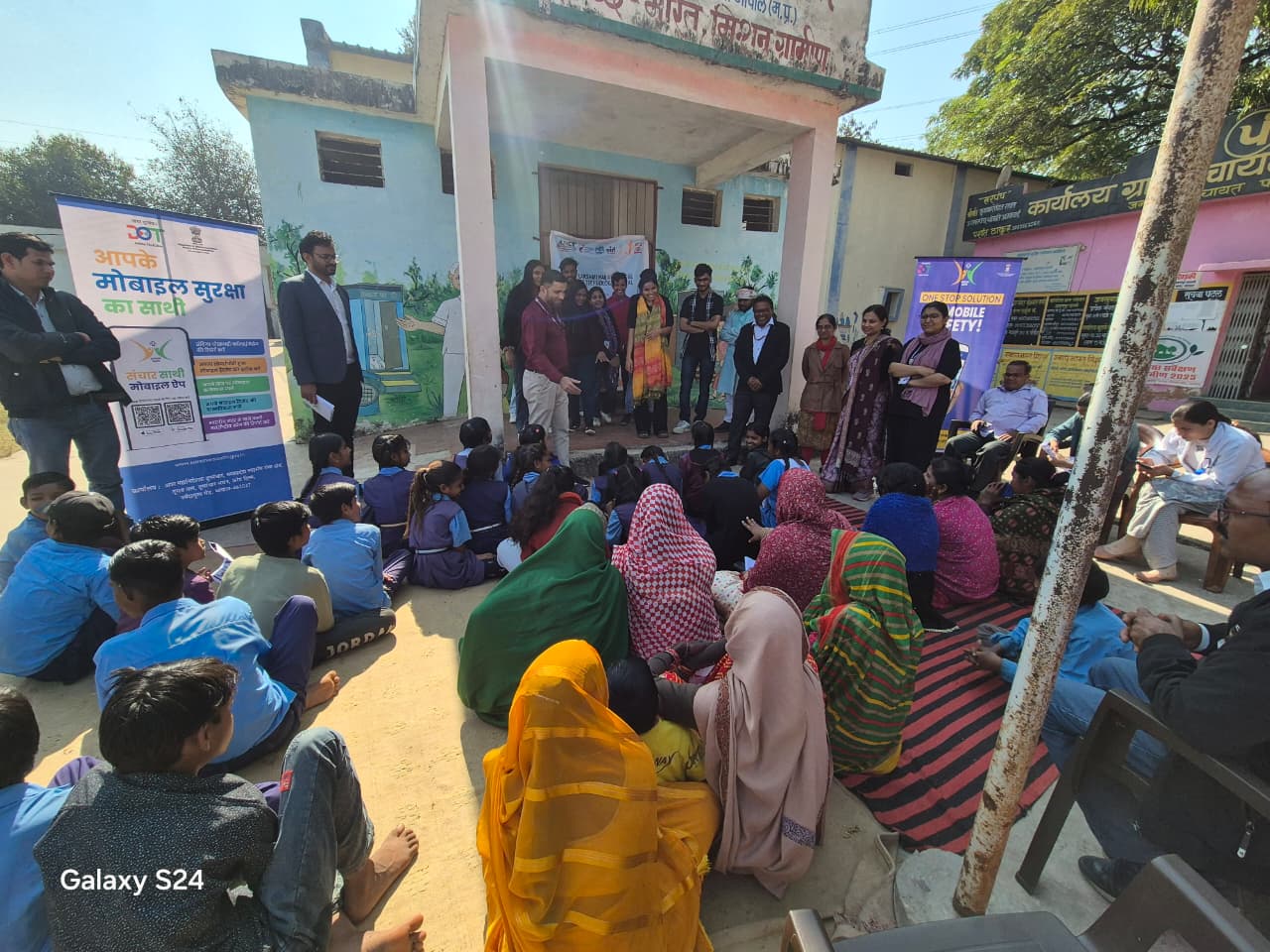
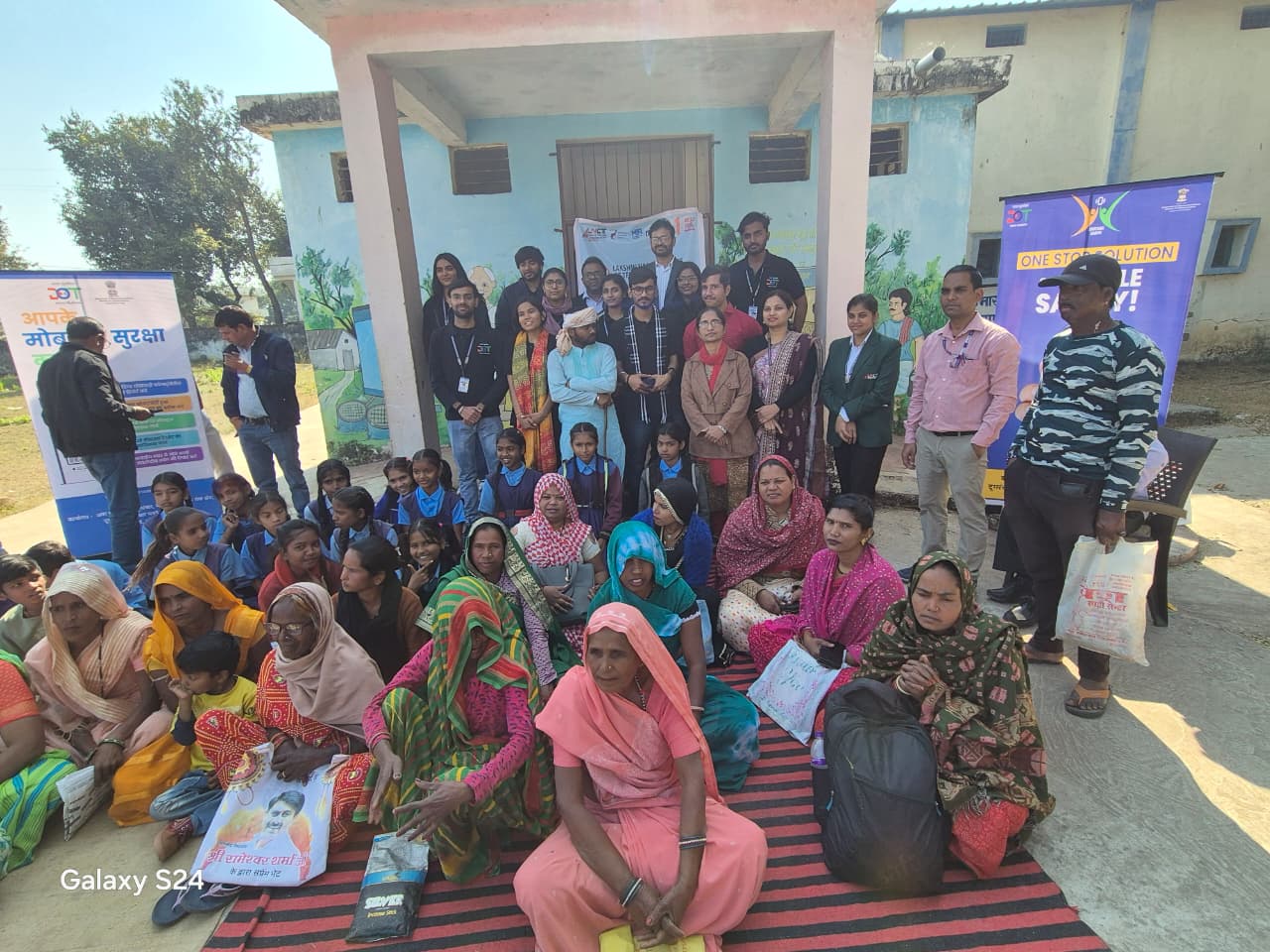
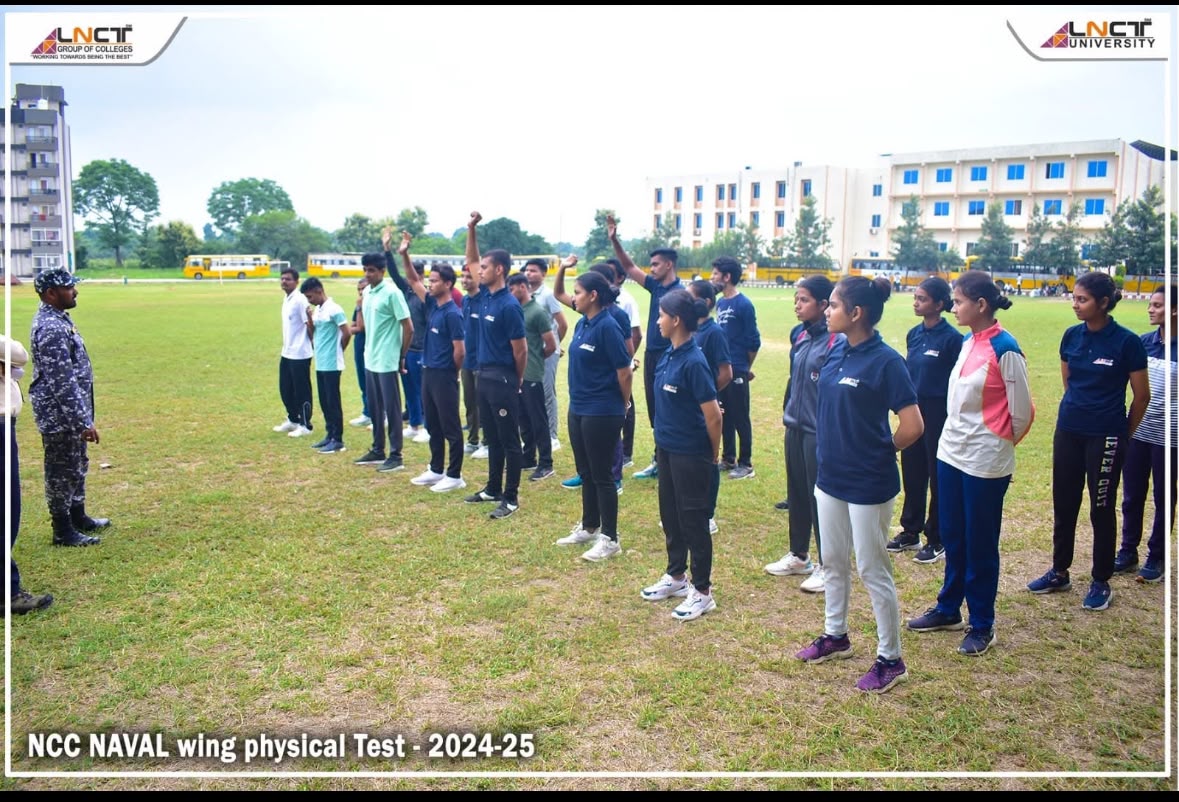
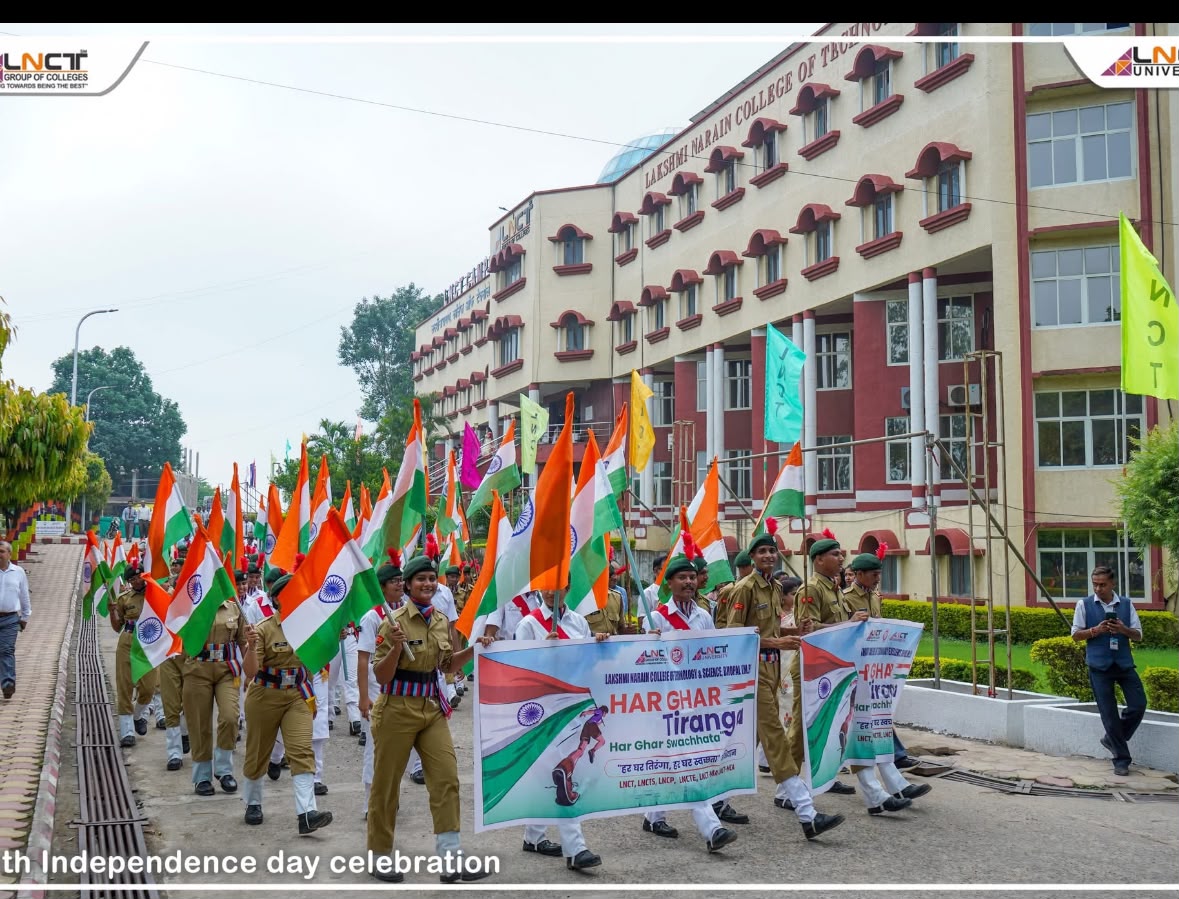
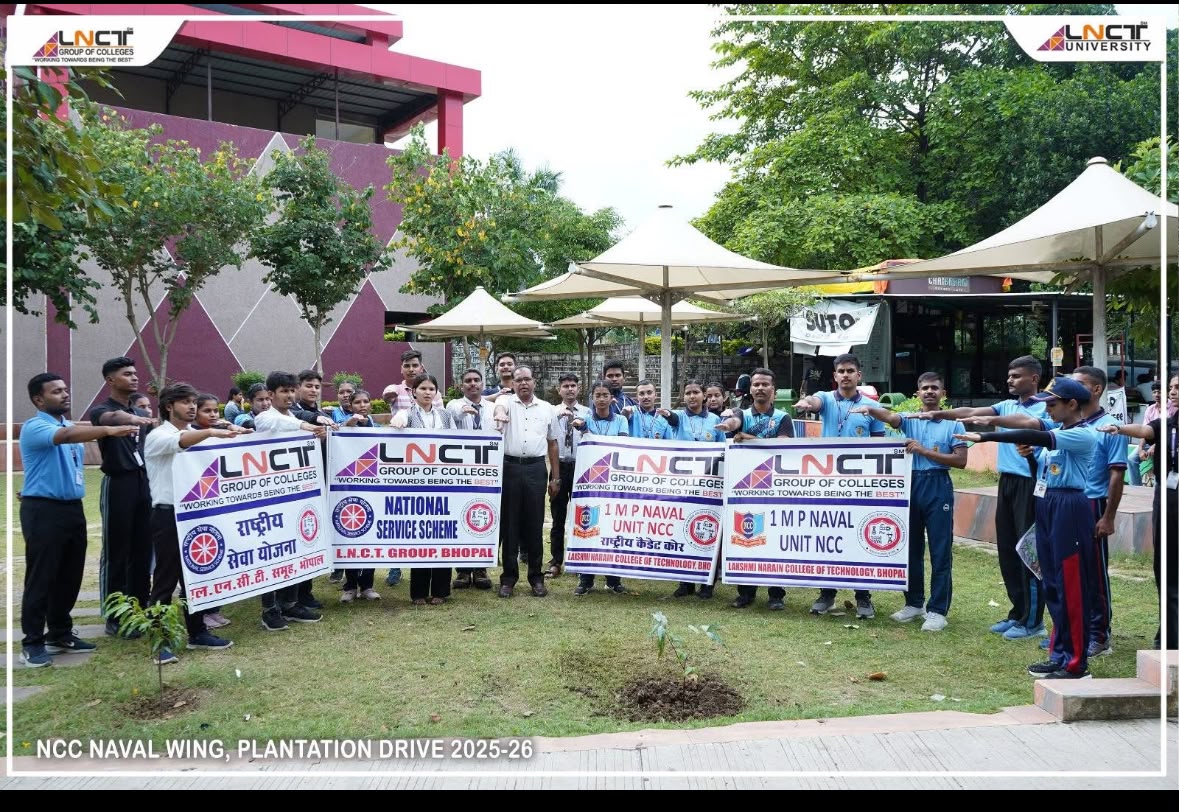
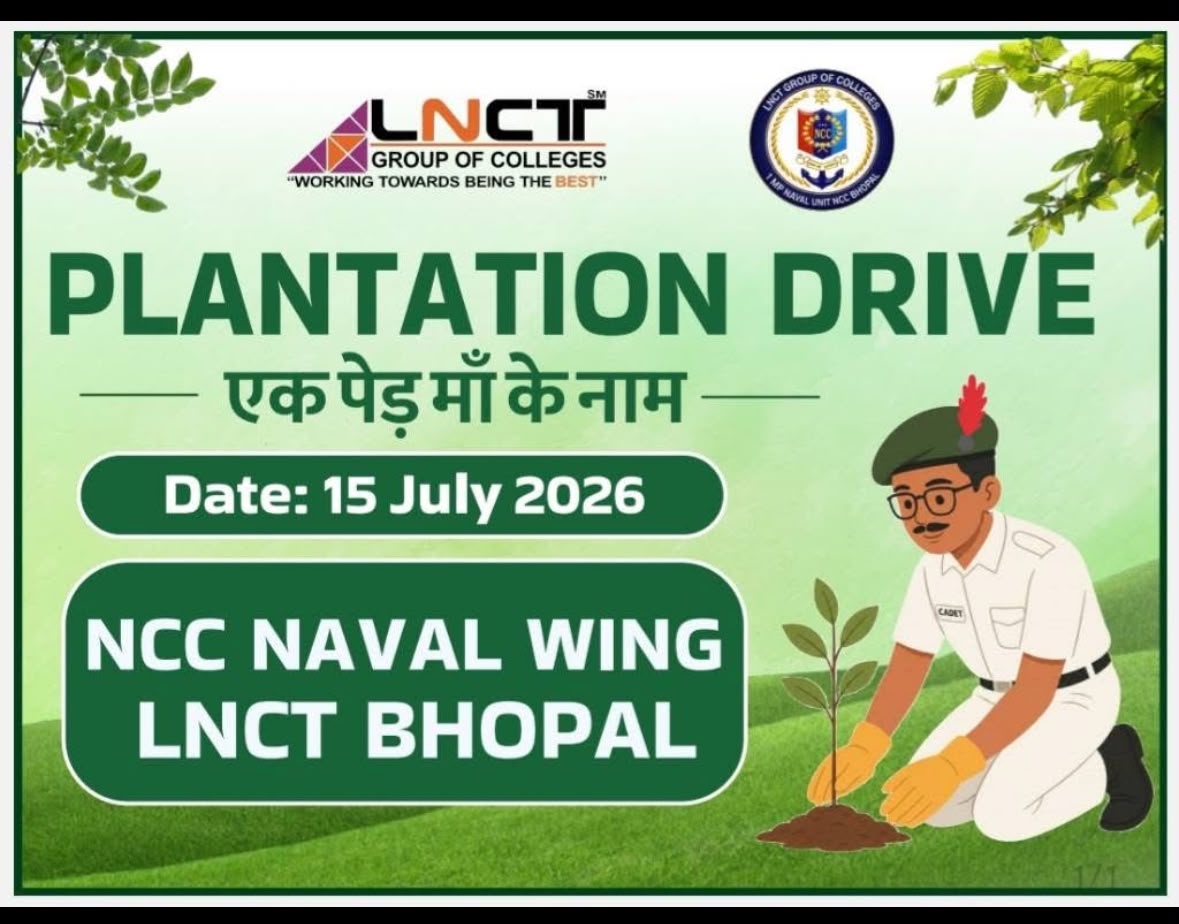
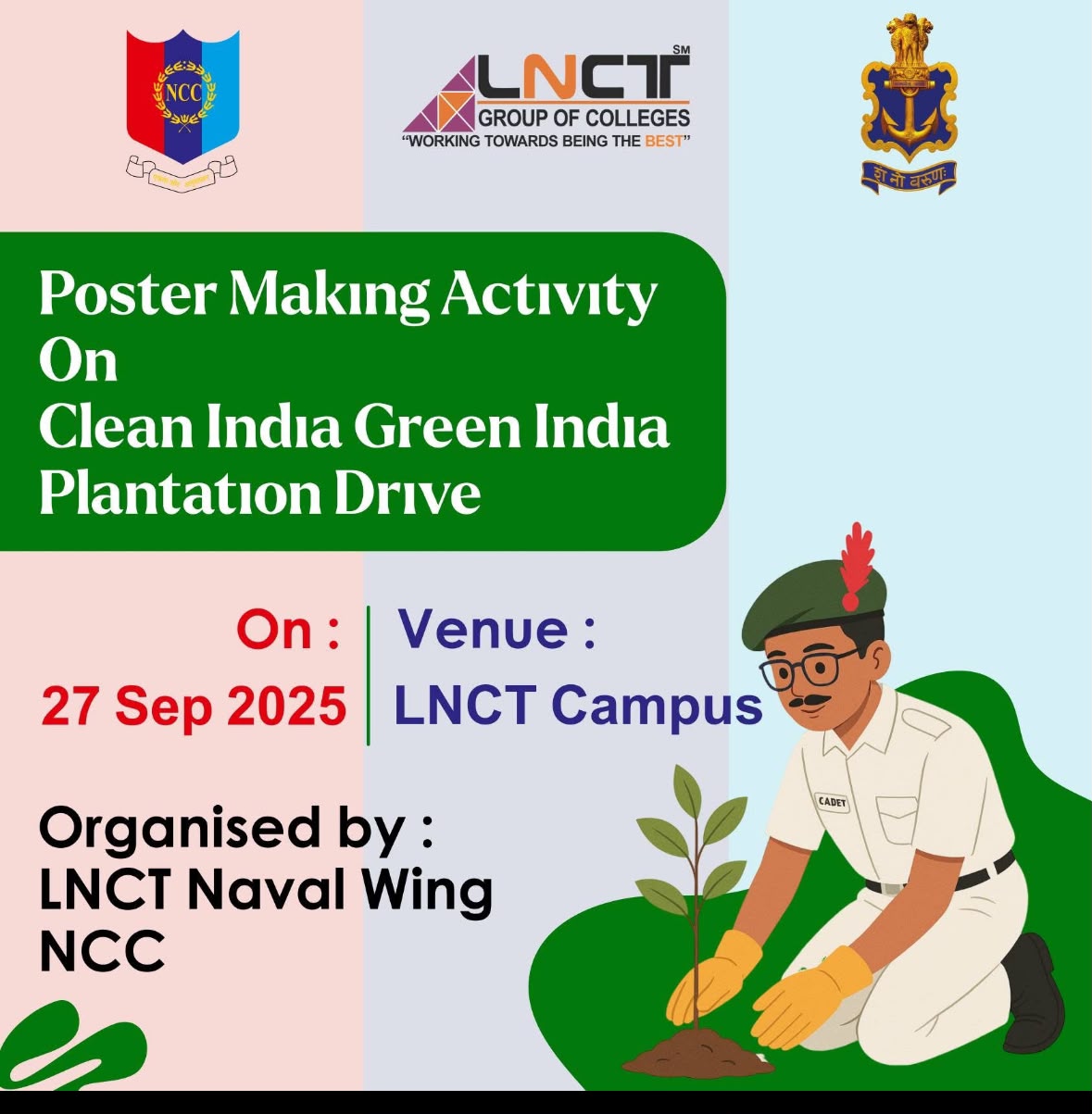
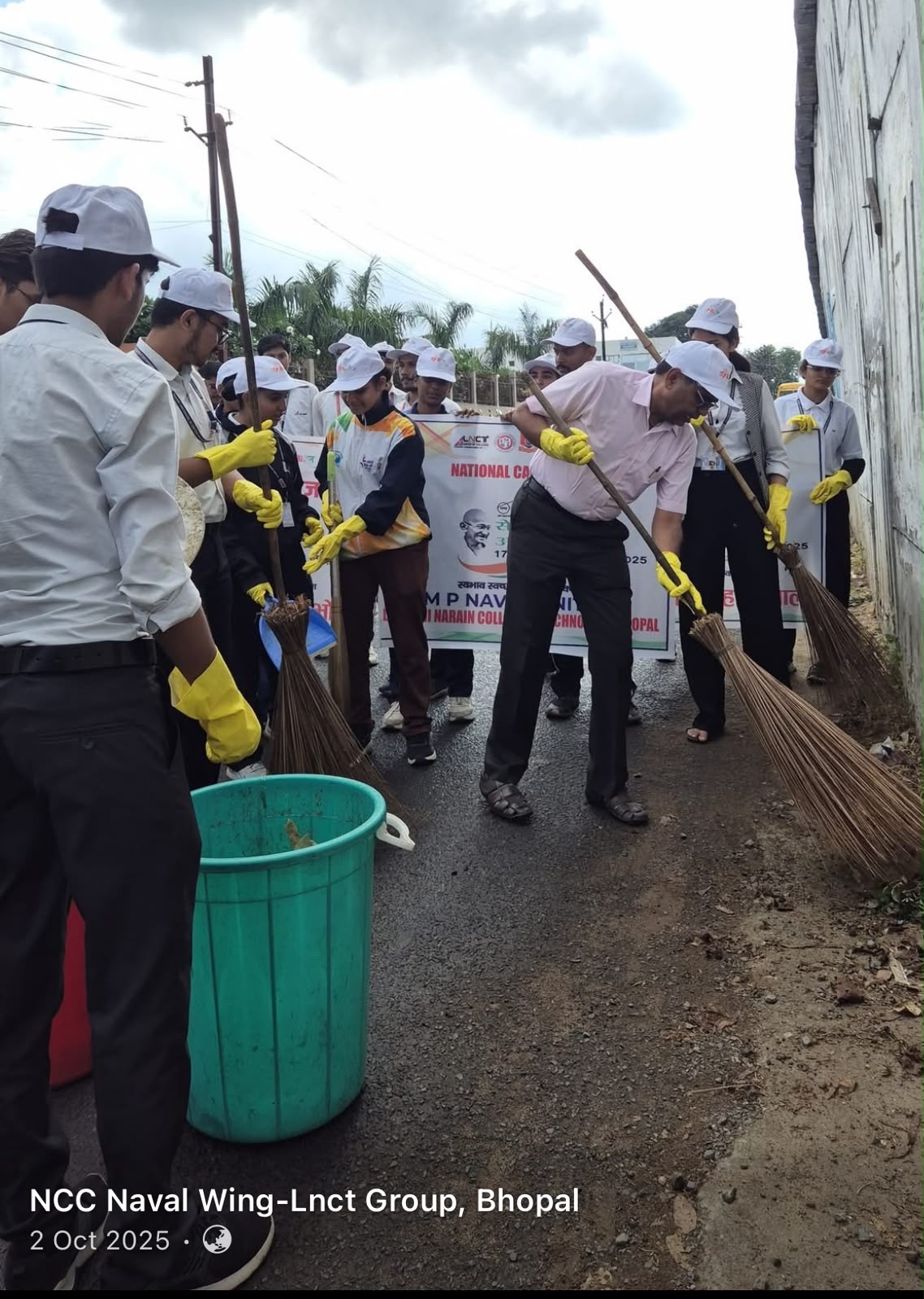
SOCIAL RESPONSIBILITY

Vision
To be recognized as Centre of Academic Excellence by imparting quality teaching and strengthening research and development activities with world class infrastructure in the field of Electronics and Communication Engineering.
Mission
M1: To impart application-oriented and in-depth engineering knowledge in all relevant areas through effective teaching–learning processes.
M2: To establish and continuously enhance state-of-the-art laboratories and research facilities by promoting internal initiatives, industry collaboration and externally funded research.
M3: To equip students with practical skills, employability competencies and entrepreneurial abilities to meet current and emerging professional requirements.
M4: To inculcate teamwork, ethical values, leadership qualities and professional responsibility among students for successful engineering practice and societal contribution.
Program Specific Outcomes (PSOs)
PSO1: Apply fundamental concepts of science and engineering to analyze and design electronic systems in core areas such as Electronic Devices and Circuits, Analog & Digital Communication, Signals & Systems, Embedded Systems, VLSI Design and related domains.
PSO2: Develop proficiency in modern engineering tools and hands-on skills including circuit simulation, MATLAB, HDL programming, DSP, embedded systems and PCB design to solve real-world engineering problems.
PSO3: Demonstrate professional ethics, teamwork, effective communication and project management skills to solve engineering problems, engage in research and industry-oriented projects and pursue lifelong learning.
Program Educational Objectives (PEOs)
PEO1: Graduates will apply knowledge of mathematics, science and engineering fundamentals to analyze and solve real world problems in Electronics and Communication Engineering and related interdisciplinary domains. Department of Electronics & Communication Engineering Lakshmi Narain College of Technology, Bhopal
PEO2: Graduates will establish successful professional careers in ECE and IT industries, pursue higher education or become entrepreneurs by effectively using modern tools, technologies and ICT skills while addressing global, economic and environmental challenges.
PEO3: Graduates will demonstrate professionalism, ethical conduct, effective communication, teamwork and apply engineering solutions responsibly to meet societal needs with a commitment to sustainability.
Annexure-II: Program Outcomes (POs)
PO1: Engineering Knowledge: Apply knowledge of mathematics, natural science, computing, engineering fundamentals and an engineering specialization as specified in WK1 to WK4 respectively to develop to the solution of complex engineering problems.
PO2: Problem Analysis: Identify, formulate, review research literature and analyze complex engineering problems reaching substantiated conclusions with consideration for sustainable development. (WK1 to WK4)
PO3: Design/Development of Solutions: Design creative solutions for complex engineering problems and design/develop systems/components/processes to meet identified needs with consideration for the public health and safety, whole-life cost, net zero carbon, culture, society and environment as required. (WK5)
PO4: Conduct Investigations of Complex Problems: Conduct investigations of complex engineering problems using research-based knowledge including design of experiments, modelling, analysis & interpretation of data to provide valid conclusions. (WK8).
PO5: Engineering Tool Usage: Create, select and apply appropriate techniques, resources and modern engineering & IT tools, including prediction and modelling recognizing their limitations to solve complex engineering problems. (WK2 and WK6)
PO6: The Engineer and The World: Analyze and evaluate societal and environmental aspects while solving complex engineering problems for its impact on sustainability with reference to economy, health, safety, legal framework, culture and environment. (WK1, WK5, and WK7).
PO7: Ethics: Apply ethical principles and commit to professional ethics, human values, diversity and inclusion; adhere to national & international laws. (WK9)
PO8: Individual and Collaborative Team work: Function effectively as an individual, and as a member or leader in diverse/multi-disciplinary teams.
PO9: Communication: Communicate effectively and inclusively within the engineering community and society at large, such as being able to comprehend and write effective reports and design documentation, make effective presentations considering cultural, language, and learning differences
PO10: Project Management and Finance: Apply knowledge and understanding of engineering management principles and economic decision-making and apply these to one’s own work, as a member and leader in a team, and to manage projects and in multidisciplinary environments.
PO11: Life-Long Learning: Recognize the need for, and have the preparation and ability for i) independent and life-long learning ii) adaptability to new and emerging technologies and iii) critical thinking in the broadest context of technological change. (WK8)
Annexure I: Knowledge and Attitude Profile (WK)
WK1: A systematic, theory-based understanding of the natural sciences applicable to the discipline and awareness of relevant social sciences.
WK2: Conceptually-based mathematics, numerical analysis, data analysis, statistics and formal aspects of computer and information science to support detailed analysis and modelling applicable to the discipline.
WK3: A systematic, theory-based formulation of engineering fundamentals required in the engineering discipline.
WK4: Engineering specialist knowledge that provides theoretical frameworks and bodies of knowledge for the accepted practice areas in the engineering discipline; much is at the forefront of the discipline.
WK5: Knowledge, including efficient resource use, environmental impacts, whole-life cost, reuse of resources, net zero carbon, and similar concepts, that supports engineering design and operations in a practice area.
WK6: Knowledge of engineering practice (technology) in the practice areas in the engineering
discipline.
WK7: Knowledge of the role of engineering in society and identified issues in engineering practice in the discipline, such as the professional responsibility of an engineer to public safety and sustainable development.
WK8: Engagement with selected knowledge in the current research literature of the discipline, awareness of the power of critical thinking and creative approaches to evaluate emerging issues.
WK9: Ethics, inclusive behavior and conduct. Knowledge of professional ethics, responsibilities, and norms of engineering practice. Awareness of the need for diversity by reason of ethnicity, gender, age, physical ability etc. with mutual understanding and respect, and of inclusive attitudes.